>
Ophidiiformes (Cusk eels) >
Dinematichthyidae (Viviparous brotula)
Etymology: Pseudogilbia: Named for J. Douglas Ogilby, an Australian ichthyologist; refers to the general resemblance to Ogilbia; sanblasensis: Named for its type locality, San Blas Archipelago, Caribbean Panama.
More on authors: Møller, Schwarzhans & Nielsen.
Umwelt: Milieu / Klimazone / Tiefenbereich / Verbreitungsgebiet
Ökologie
seewasser riff-verbunden. Tropical
Western Atlantic: Caribbean Panama.
Größe / Gewicht / Alter
Geschlechtsreife: Lm ? range ? - ? cm
Max length : 6.6 cm SL Männchen/unbestimmt; (Ref. 55786)
Kurzbeschreibung
Bestimmungsschlüssel | Morphologie | Morphometrie
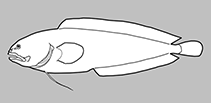
Rückenflossenweichstrahlen (insgesamt) : 69; Afterflossenweichstrahlen: 56; Wirbelzahl: 41. This species is distinguished by the following characters: anterior nostril placed low on snout; tip of opercular spine free; male copulatory organs with 2 pairs of equally sized psedoclaspers, larger than in all other American dinematichthyine species; inner pseudoclasper formed like a forward-pointing hook; eyes large (2.9% SL); head with broad scale patch on cheek; otolith with fused colliculi; 1 lower preopercular pore; maxillary knob at rear corner; 3 elongated rakers on anterior gill arch; anterior anal fin pterygiophore long; predorsal length long (35.3% SL), ventral fins short (16.4% SL), ending well in front of the anal opening (Ref. 55786).
Lebenszyklus und Paarungsverhalten
Geschlechtsreife | Fortpflanzung | Ablaichen | Eier | Fruchtbarkeit | Larven
Møller, P.R., W. Schwarzhans and J.G. Nielsen, 2004. Review of the American Dinematichthyini (Teleostei, Bythitidae). Part I. Dinematichthys, Gunterichthys, Typhliasina and two new genera. aqua, J. Ichthyol. Aquat. Biol. 8(4):141-192. (Ref. 55786)
IUCN Rote Liste Status (Ref. 130435: Version 2025-2 (Global))
Bedrohung für Menschen
Harmless
Nutzung durch Menschen
Tools
Zusatzinformationen
Download XML
Internet Quellen
Schätzungen auf der Grundlage von Modellen
Phylogenetischer Diversitätsindex (Ref.
82804): PD
50 = 1.0000 [Uniqueness, from 0.5 = low to 2.0 = high].
Bayesian length-weight: a=0.00389 (0.00180 - 0.00842), b=3.12 (2.94 - 3.30), in cm total length, based on all LWR estimates for this body shape (Ref.
93245).
Trophische Ebene (Ref.
69278): 3.3 ±0.5 se; based on size and trophs of closest relatives
Anfälligkeit der Fischerei (Ref.
59153): Low vulnerability (10 of 100).
🛈