>
Ophidiiformes (Cusk eels) >
Dinematichthyidae (Viviparous brotula)
Etymology: Ogilbichthys: Named for the great Australian ichthyologist, J. Douglas Ogilby; longimanus: Named for the long pectoral fins which are longer than in any other American dinematichthyine.
Eponymy: James Douglas Ogilby (1853–1925) was an Irish-born Australian ichthyologist and taxonomist, son of the famous zoologist William Ogilby (below). [...] (Ref. 128868), visit book page.
More on authors: Møller, Schwarzhans & Nielsen.
Ambiente: milieu / zona climática / intervalo de profundidade / gama de distribuição
Ecologia
marinhas associadas(os) a recifes; intervalo de profundidade 0 - 15 m (Ref. 55786). Tropical
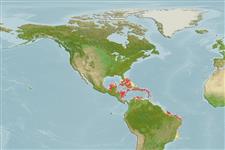
Western Central Atlantic: off Cayman Islands, Bahamas and Haiti.
Tamanho / Peso / Idade
Maturidade: Lm ? range ? - ? cm
Max length : 7.3 cm SL (female)
Descrição breve
Chaves de identificação | Morfologia | Morfometria
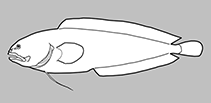
Raios dorsais moles (total) : 70 - 79; Raios anais moles: 55 - 64; Vértebras: 40 - 43. This species is characterized by the following: pectoral fins long (16.7-20.3% SL); soft interorbital broad (7-9.4%SL); pectoral distance long (33.2-37.4%SL); elongate neural spines 4; rows of large scales on lower cheeks 3; outer pseudoclasper a broad, rounded lobe; fleshy isthmus between pseudoclaspers wide; anterior inner pseudoclasper submerged in pocket of isthmus; otolith with fused colliculi (Ref. 55786).
Ciclo de vida e comportamento de acasalamento
Maturidade | Reprodução | Desova | Ovos | Fecundidade | Larvas
Møller, P.R., W. Schwarzhans and J.G. Nielsen, 2004. Review of the American Dinematichthyini (Teleostei, Bythitidae). Part I. Dinematichthys, Gunterichthys, Typhliasina and two new genera. aqua, J. Ichthyol. Aquat. Biol. 8(4):141-192. (Ref. 55786)
Categoria na Lista Vermelha da IUCN (Ref. 130435: Version 2025-2 (Global))
Ameaça para o homem
Harmless
Utilização humana
Ferramentas
Relatórios especiais
Descarregue XML
Fontes da internet
Estimativas baseadas em modelos
Temperatura preferida (Ref.
123201): 26.5 - 28.1, mean 27.5 °C (based on 409 cells).
Índice de diversidade filogenética (Ref.
82804): PD
50 = 0.5078 [Uniqueness, from 0.5 = low to 2.0 = high].
Bayesian length-weight: a=0.00389 (0.00180 - 0.00842), b=3.12 (2.94 - 3.30), in cm total length, based on all LWR estimates for this body shape (Ref.
93245).
Nível Trófico (Ref.
69278): 3.3 ±0.5 se; based on size and trophs of closest relatives
Vulnerabilidade da pesca (Ref.
59153): Low vulnerability (10 of 100).
🛈