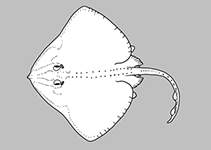
Elasmobranchi (squali e razze) (sharks and rays) >
Rajiformes (Skates and rays) >
Arhynchobatidae (Softnose skates)
Etymology: microspinifera: Name from Latin 'micro' meaning small and the epithet of its larger New Zealand sibling species Brochiraja spinifera.
More on authors: Last & McEachran.
Ambiente: milieu / zona climatica / distribuzione batimetrica / gamma di distribuzione
Ecologia
marino batidemersale; distribuzione batimetrica 600 - 1200 m (Ref. 58023). Deep-water
Southwest Pacific: New Zealand.
Dimensione / Peso / Età
Maturità: Lm ? range ? - ? cm
Max length : 32.5 cm TL maschio/sesso non determinato; (Ref. 58023)
Breve descrizione
Chiavi di identificazione | Morfologia | Morfometria
A dwarf species with the following combination of characters: tail moderately elongate, 1.2-1.4 times disc length, 2.5-2.7 times ventral head length, 5.3-6.3 times snout length; orbit moderately large, 2.1-2.8 in preorbital snout length; tail base moderately broad, width at pelvic-fin insertions 2.1-3.1 times width at midlength; fine dermal dentic1es present over entire dorsal disc; rostral thorns reduced in adult, about equidistant from orbit and snout tip (snout length 1.8-2.1 times their distance from snout tip); mid-dorsal surface of tail naked apart from single row of moderately enlarged thorns extending anteriorly onto interpelvic space; dorsolateral surface of tail with numerous smaller thorns and large denticles; single preorbital thorn, postorbital thorn absent; ventral disc and tail naked; calcified rostral shaft short; alar thorns in small, well-defined patch; malar thorns absent; both surfaces of disc dark brown; with or without pale-edged pores on ventral surface; nuchal pore band indistinct; total pectoral radials 58-63; predorsal vertebrae 81-88; tooth rows in the upper jaw 33-37 (Ref. 58023).
Body shape (shape guide): other.
Male paratype mature at 27 cm TL; no information on juveniles (Ref. 58023).
Ciclo vitale e comportamento di accoppiamento
Maturità | Riproduzione | Deposizione | Uova | Fecondità | Larve
Last, P.R. and J.D. McEachran, 2006. New softnose skate genus Brochiraja from New Zealand (Rajidae: Arhynchobatinae) with description of four new species. N. Z. J. Mar. Freshwater Res. 40(1):65-90. (Ref. 58023)
Stato della Lista Rossa IUCN (Ref. 130435: Version 2025-2 (Global))
Minaccia per l'uomo
Harmless
Usi umani
Strumenti
Rapporti speciali
Scarica XML
Fonti Internet
Stime basate su modelli
Temperatura preferita (Fonte Biblio.
123201): 3.6 - 8.2, mean 5.3 °C (based on 20 cells).
Indice di diversità filogenetica (Fonte Biblio.
82804): PD
50 = 0.5039 [Uniqueness, from 0.5 = low to 2.0 = high].
Bayesian length-weight: a=0.00550 (0.00279 - 0.01081), b=3.11 (2.94 - 3.28), in cm total length, based on LWR estimates for this (Sub)family-body shape (Ref.
93245).
Livello trofico (Fonte Biblio.
69278): 3.7 ±0.6 se; based on size and trophs of closest relatives
Resilienza (Fonte Biblio.
120179): Basso, tempo minimo di raddoppiamento della popolazione 4.5 - 14 anni (Preliminary low fecundity).
Vulnerabilità della pesca (Ref.
59153): Low vulnerability (23 of 100).
🛈