Elasmobranchi (squali e razze) (sharks and rays) >
Rhinopristiformes (Shovelnose rays) >
Rhinobatidae (Guitarfishes)
Etymology: Rhinobatos: Greek, rhinos = nose + Greek, batis, -idos = a ray (Raja sp.) (Ref. 45335); sainsburyi: Named for Dr. Keith Sainsbury.
Eponymy: Dr Keith John Sainsbury (d: 1952) is a marine ecologist and mathematical modeler with a research focus on the assessment, ecology, economics, exploitation and conservation of marine resources and ecosystems. [...] (Ref. 128868), visit book page.
More on author: Last.
Ambiente: milieu / zona climatica / distribuzione batimetrica / gamma di distribuzione
Ecologia
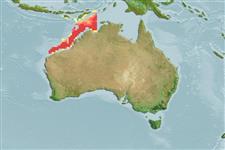
marino benthopelagico; distribuzione batimetrica 66 - 200 m (Ref. 58070), usually ? - 150 m (Ref. 58070). Tropical; 5°S - 21°S, 114°E - 135°E (Ref. 114953)
Eastern Indian Ocean and Western Central Pacific: Western Australia to Papua New Guinea
Dimensione / Peso / Età
Maturità: Lm ? range ? - ? cm
Max length : 59.5 cm TL maschio/sesso non determinato; (Ref. 58070)
Breve descrizione
Chiavi di identificazione | Morfologia | Morfometria
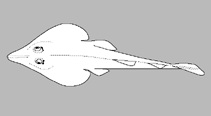
This species is distinguished by the following characters: wedge-shaped disc, its dorsal surface scaled but no thorns; snout length 2.5-2.6 times interspiracular distance; orbit moderately large, diameter 1.6-1.9 times spiracle length; nostrils oblique, length 1.4-1.6 times internarial distance; anterior nasal-flaps inserted well into internarial space, but never almost united near ventral midline; posterior nasal flaps broad; ridges of rostral cartilage well-separated dorsally and almost parallel; prebranchial sensory-pore patch narrow, extending to first gill slit; distance between first gill slits 1.3-1.4 times distance between fifth gill slits; distance between fifth gill slits 2.5-2.9 times in ventral head length; postscapular sensory canal long, not grooved, extending more than three-quarters distance to pectoral-fin insertions; moderately tall dorsal-fins; pelvic-fin inner margin distinctly longer than its base in mature males, shorter than base in females; interdorsal distance more than 2.5 times first dorsal-fin base; outer spiracular fold distinctly larger than inner fold; dorsal margin of caudal fin about 2.0-2.2 times preventral margin; 162-171 post-synarcual vertebral centra; about 50 nasal lamellae; dorsal disc plain brownish or with faint dusky blotches or fine dark spots (Ref. 58070).
Body shape (shape guide): elongated.
This species is mostly collected at depths shallower than 150 m. Male individuals mature at 46 cm TL, immature at 37.6 cm TL (Ref. 58070).
Ciclo vitale e comportamento di accoppiamento
Maturità | Riproduzione | Deposizione | Uova | Fecondità | Larve
Last, P.R., 2004. Rhinobatos sainsburyi n. sp. and Aptychotrema timorensis n. sp. -- two new shovelnose rays (Batoidea: Rhinobatidae) from the eastern Indian Ocean. Rec. Aust. Mus. 56(2):201-208. (Ref. 58070)
Stato della Lista Rossa IUCN (Ref. 130435: Version 2025-2 (Global))
Minaccia per l'uomo
Harmless
Usi umani
Strumenti
Rapporti speciali
Scarica XML
Fonti Internet
Stime basate su modelli
Temperatura preferita (Fonte Biblio.
123201): 20.5 - 26.8, mean 23.9 °C (based on 45 cells).
Indice di diversità filogenetica (Fonte Biblio.
82804): PD
50 = 0.5000 [Uniqueness, from 0.5 = low to 2.0 = high].
Bayesian length-weight: a=0.00295 (0.00150 - 0.00581), b=3.13 (2.96 - 3.30), in cm total length, based on LWR estimates for this (Sub)family-body shape (Ref.
93245).
Livello trofico (Fonte Biblio.
69278): 3.7 ±0.4 se; based on size and trophs of closest relatives
Resilienza (Fonte Biblio.
120179): Basso, tempo minimo di raddoppiamento della popolazione 4.5 - 14 anni (Preliminary low fecundity).
Vulnerabilità della pesca (Ref.
59153): Moderate vulnerability (44 of 100).
🛈