>
Cypriniformes (Carps) >
Cobitidae (Spined loaches)
Etymology: elongata: From the Latin adjective elongatus,-a,-um, meaning elongate.
Ambiente: milieu / zona climática / intervalo de profundidade / gama de distribuição
Ecologia
; Água doce demersal. Tropical
Asia: Tenasserim and Mitan Chaung streams in Myanmar.
Tamanho / Peso / Idade
Maturidade: Lm ? range ? - ? cm
Max length : 4.8 cm SL macho/indeterminado; (Ref. 57993)
Descrição breve
Chaves de identificação | Morfologia | Morfometria
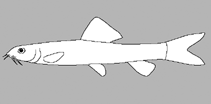
Raios dorsais moles (total) : 9; Raios anais moles: 8; Vértebras: 57 - 62. Differs from all its congeners, except P. doriae and P. pulla, by the number of abdominal vertebrae. Can be differentiated from P. pulla by the presence of pelvic girdle and fins (vs. absence) and the plain light brown coloration (vs. blackish brown with 20-25 narrow vertical bars), and from P. doriae by the absence of a nasal barbel (vs. presence) and fewer caudal vertebrae (13-15 vs. 15-18). Can be distinguished further from the Myanmar species of Pangio with pelvic girdle and fins by the position of the basipterygia relative to the vertebral column (at level of vertebra 33 vs. at level of vertebra 29 in P. signicauda and P. lumbrici[ormis, and at level of vertebra 23-24 in P. pangia), from P. signicauda and P. lumbriciformis by the uniform, plain brown coloration (vs. color pattern with dark marks on body and fins), from P. fusca and P. pangia by the more slender, elongate body (body depth 7.8 % SL vs. 8.7-12.0 in P. pangia and 13.5-16.3 in P. fusca) and narrower (caudal peduncle depth 5 % SL vs. 5.9-9.7) and longer caudal peduncle (14.9 % SL vs. 9.5-12.5), from P. fusca by the presence of pelvic fins and girdle (vs. absence) and the absence of a nasal barbel (vs. presence), and from P. pangia by a more slender body (body depth 7.8 % SL vs. 13.5-16.3), shorter pectoral fin (5.3 % SL vs. 8.2-9.6) and relatively more anteriorly placed pelvic fins (prepelvic length 56.3 % SL vs. 79.0-86.8) (Ref. 57993).
Body shape (shape guide): elongated.
Facultative air-breathing in the genus (Ref. 126274)
Ciclo de vida e comportamento de acasalamento
Maturidade | Reprodução | Desova | Ovos | Fecundidade | Larvas
Britz, R. and J. Maclaine, 2007. A review of the eel-loaches, genus Pangio, from Myanmar (Teleostei: Cypriniformes: Cobitidae). Ichthyol. Explor. Freshwat. 18(1):17-30. (Ref. 57993)
Categoria na Lista Vermelha da IUCN (Ref. 130435: Version 2025-2 (Global))
Ameaça para o homem
Harmless
Utilização humana
Pescarias: sem interesse
Ferramentas
Relatórios especiais
Descarregue XML
Fontes da internet
Estimativas baseadas em modelos
Índice de diversidade filogenética (Ref.
82804): PD
50 = 0.5000 [Uniqueness, from 0.5 = low to 2.0 = high].
Bayesian length-weight: a=0.00501 (0.00233 - 0.01079), b=3.08 (2.90 - 3.26), in cm total length, based on LWR estimates for this (Sub)family-body shape (Ref.
93245).
Nível Trófico (Ref.
69278): 3.3 ±0.4 se; based on size and trophs of closest relatives
Resiliência (Ref.
120179): Elevada, tempo mínimo de duplicação da população menor que 15 meses (Preliminary K or Fecundity.).
Vulnerabilidade da pesca (Ref.
59153): Low vulnerability (10 of 100).
🛈