>
Clupeiformes (Herrings) >
Engraulidae (Anchovies) > Coiliinae
Etymology: Coilia: Greek, koilia, -as = abdomen, hollow (Ref. 45335).
Eponymy: Johann Heinrich Andreaus Bernhard Sonnemann Rebentisch was a Dutch military health officer (he was Surgeon Colonel in Sinkawang, a city in Indonesian Borneo) who collected (1858–1859) specimens of fish for Bleeker, including the holotype of this [...] (Ref. 128868), visit book page.
More on author: Bleeker.
Environnement : milieu / zone climatique / profondeur / gamme de distribution
Écologie
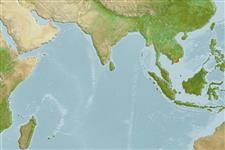
marin; saumâtre pelagic-neritic; profondeur 0 - 50 m (Ref. 189). Tropical; 14°N - 1°N, 106°E - 111°E (Ref. 189)
Western Central Pacific: Indonesia (western coast of Kalimantan), Malaysia, Brunei, and Viet Nam (Saigon).
Taille / Poids / Âge
Maturité: Lm ? range ? - ? cm
Max length : 15.2 cm SL mâle / non sexé; (Ref. 189)
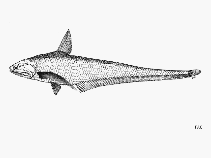
Épines dorsales (Total) : 0; Épines anales: 0; Rayons mous anaux: 80. Body tapering, belly rounded in front of pelvic fins, with at most 1 + 10 to 12 = 11 to 13 keeled scutes from just before pelvic fin base to anus. Maxilla short, not reaching beyond edge of gill cover. Pectoral fin with 16 to 19 long filaments and 7 to 10 branched fin rays, much shorter than those of pelvic fin.
Body shape (shape guide): elongated; Cross section: compressed.
Occurs in coastal waters and estuaries, but the extent of its movements into the sea or up rivers is not known. Scarce in museum collections but this may not reflect its actual abundance.
Cycle de vie et comportement reproducteur
Maturité | Reproduction | Frai | Œufs | Fécondité | Larves
Spawn in school (Ref. 205).
Wongratana, T., T.A. Munroe and M. Nizinski, 1999. Order Clupeiformes. Engraulidae. Anchovies. p. 1698-1753. In K.E. Carpenter and V.H. Niem (eds.) FAO species identification guide for fishery purposes. The living marine resources of the WCP. Vol. 3. Batoid fishes, chimaeras and bony fishes part 1 (Elopidae to Linophrynidae). FAO, Rome. (Ref. 9822)
Statut dans la liste rouge de l'IUCN (Ref. 130435: Version 2025-2 (Global))
Menace pour l'homme
Harmless
Utilisations par l'homme
Pêcheries: pêcheries vivrières
Outils
Articles particuliers
Télécharger en XML
Sources Internet
Estimations basées sur des modèles
Indice de diversité phylogénétique (Réf.
82804): PD
50 = 0.5001 [Uniqueness, from 0.5 = low to 2.0 = high].
Bayesian length-weight: a=0.00282 (0.00123 - 0.00644), b=3.10 (2.92 - 3.28), in cm total length, based on LWR estimates for this Genus-body shape (Ref.
93245).
Niveau trophique (Réf.
69278): 3.3 ±0.4 se; based on size and trophs of closest relatives
Résilience (Réf.
120179): Haut, temps minimum de doublement de population inférieur à 15 mois (Preliminary K or Fecundity.).
Vulnérabilité de la pêche (Ref.
59153): Low vulnerability (10 of 100).
🛈