>
Ophidiiformes (Cusk eels) >
Bythitidae (Livebearing brotulas)
Etymology: Lucifuga: Latin, lux = light + latin, fugere = to escape, to avoid, to run away from (Ref. 45335); lucayana: Named for its type locality, Lucayan Caverns, graveyard of the Lucayan Indians who inhabited the Bahamas for 2000 years and were eliminated by the European invaders.
More on authors: Møller, Schwarzhans, Iliffe & Nielsen.
Environnement : milieu / zone climatique / profondeur / gamme de distribution
Écologie
marin benthopélagique; profondeur 12 - 20 m (Ref. 57878). Subtropical
Distribution
Territoires | Zones FAO | Écosystèmes | Occurrences | Carte par point | Introductions | Faunafri
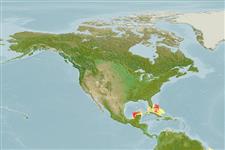
Western Atlantic: Caribbean, Bahamas.
Taille / Poids / Âge
Maturité: Lm ? range ? - ? cm
Max length : 9.9 cm SL (female)
Description synthétique
Clés d'identification | Morphologie | Morphométrie
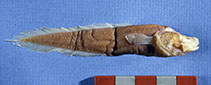
Rayons mous dorsaux (Total) : 84 - 91; Rayons mous anaux: 63 - 69; Vertèbres: 50 - 52. This species is distinguished from its congeners by the following combination of characters: Vertebrae 12-13+37-39=50-52, dorsal fin rays 84-91, anal fin rays 63-69, pectoral fin rays 17-18, caudal fin rays 10; head profile above eye strongly depressed, scales on occiput, eyes present (0.9-1.0 % SL); palatine teeth absent; color uniformly light brown, long gill-rakers 3, pale (Ref. 57878).
Body shape (shape guide): elongated.
Found in an anchialine cave which is connected to the sea via a submerged passage which opens into a tidal saltwater creek. The upper about 14 m in the cave consists of freshwater (22 °C), separated from a lower, slightly warmer (23-25 °C), salty layer by a distinct halocline. The holotype was taken in a depth of 12 m, which must then most likely to be freshwater; some where collected from one or two inland sink holes (Ref. 57878).
Cycle de vie et comportement reproducteur
Maturité | Reproduction | Frai | Œufs | Fécondité | Larves
Møller, P.R., W. Schwarzhans, T.M. Iliffe and J.G. Nielsen, 2006. Revision of the Bahamian cave-fishes of the genus Lucifuga (Ophidiiformes, Bythitidae), with description of a new species from islands on the Little Bahama Bank. Zootaxa 1223:23-46. (Ref. 57878)
Statut dans la liste rouge de l'IUCN (Ref. 130435: Version 2025-2 (Global))
Menacé (EN) (B1ab(iii)+2ab(iii)); Date assessed: 26 August 2020
Menace pour l'homme
Harmless
Utilisations par l'homme
Pêcheries: sans intérêt
Outils
Articles particuliers
Télécharger en XML
Sources Internet
Estimations basées sur des modèles
Température préférée (Réf.
123201): 26.3 - 28, mean 27 °C (based on 198 cells).
Indice de diversité phylogénétique (Réf.
82804): PD
50 = 0.5039 [Uniqueness, from 0.5 = low to 2.0 = high].
Bayesian length-weight: a=0.00479 (0.00192 - 0.01191), b=3.03 (2.81 - 3.25), in cm total length, based on LWR estimates for this (Sub)family-body shape (Ref.
93245).
Niveau trophique (Réf.
69278): 3.3 ±0.5 se; based on size and trophs of closest relatives
Résilience (Réf.
120179): Haut, temps minimum de doublement de population inférieur à 15 mois (Preliminary K or Fecundity.).
Vulnérabilité de la pêche (Ref.
59153): Low vulnerability (10 of 100).
🛈