>
Cichliformes (Cichlids, convict blennies) >
Cichlidae (Cichlids) > Pseudocrenilabrinae
Etymology: Konia: Greek, konia, as = ash, sand (Ref. 45335).
Eponymy: Professor Dr Martin Eisentraut (1902–1994) was a German zoologist and collector. [...] (Ref. 128868), visit book page.
More on author: Trewavas.
Ambiente: milieu / zona climática / intervalo de profundidade / gama de distribuição
Ecologia
; Água doce bentopelágico. Tropical; 25°C - 27°C (Ref. 13614); 10°N - 3°N
Africa: endemic to Lake Barombi-Mbo, Cameroon (Ref. 81260).
Tamanho / Peso / Idade
Maturidade: Lm ? range ? - ? cm
Max length : 9.3 cm TL macho/indeterminado; (Ref. 4984)
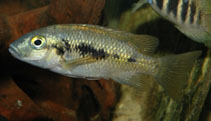
Espinhos dorsais (total) : 15 - 16; Raios dorsais moles (total) : 10 - 11; Espinhos anais: 3; Raios anais moles: 8 - 9; Vértebras: 29. Diagnosis: profile of the snout evenly decurved, descending to a nearly horizontal mouth; narrow interorbital space (24-27% head length)(Ref. 53940, 53949). Lower jaw not, or only slightly inclined from the horizontal; lower pharyngeal jaw only slightly longer than wide (Ref. 81260). Dentigerous area of lower pharyngeal bone longer than anterior blade in young and of characteristic shape, with a narrow anterior apical portion (Ref. 53949). Blade of lower pharyngeal bone 0.7-0.95 times median length of toothed area; 3 regular rows of teeth; upper series of black blotches parallel to dorsal outline; black band of uneven width extending from opercular spot to anterior part of caudal peduncle; posterior end of caudal peduncle with vertical blotch meeting its fellow over top; fins colorless; tilapia mark absent (Ref. 53940).
Body shape (shape guide): fusiform / normal.
Feeds on algae, small insects and fish eggs (Ref. 52307). Also kleptoparasite of freshwater crabs (Ref. 53950). Ovophilic mouthbrooder with both sexes as possible incubator; from aquarium observations: a few days prior to spawning, both partners remain close together for much of the time; the genital papilla of the female is clearly visible immediately before spawning and is much broader and larger than the male's; females are normally more successful than males when it comes to brooding the fry; when mouthbrooding, which ends about 3 weeks post-spawning, the specimens are relatively shy and prefer to lie silently near the bottom in secluded areas; once free swimming, juveniles normally do not return to the parent's mouth again (Ref. 52307).
Ciclo de vida e comportamento de acasalamento
Maturidade | Reprodução | Desova | Ovos | Fecundidade | Larvas
Male or female carries the egg in the mouth (Ref. 52307, Ref. 13614). A few days prior to spawning, both partners remain close together for much of the time; the genital papilla of the female is clearly visible immediately before spawning and is much broader and larger then the male's; females normally more succesfull in brooding the fry; specimens are relatively shy and prefer to lie silently near the bottom in secluded areas when mouthbrooding, which ends about three weeks post-spawning; once free swimming, the fry normally does not return to the parent's mouth (Ref. 52307).
Lamboj, A., 2004. The cichlid fishes of Western Africa. Birgit Schmettkamp Verlag, Bornheim, Germany. 255 p. (Ref. 52307)
Categoria na Lista Vermelha da IUCN (Ref. 130435: Version 2025-2 (Global))
Ameaça para o homem
Harmless
Utilização humana
Ferramentas
Relatórios especiais
Descarregue XML
Fontes da internet
Estimativas baseadas em modelos
Índice de diversidade filogenética (Ref.
82804): PD
50 = 0.7500 [Uniqueness, from 0.5 = low to 2.0 = high].
Bayesian length-weight: a=0.01445 (0.00671 - 0.03113), b=2.99 (2.82 - 3.16), in cm total length, based on LWR estimates for this (Sub)family-body shape (Ref.
93245).
Nível Trófico (Ref.
69278): 3.6 ±0.45 se; based on food items.
Resiliência (Ref.
120179): Elevada, tempo mínimo de duplicação da população menor que 15 meses (Preliminary K or Fecundity.).
Vulnerabilidade da pesca (Ref.
59153): Low vulnerability (10 of 100).
🛈