>
Ophidiiformes (Cusk eels) >
Dinematichthyidae (Viviparous brotula)
Etymology: Dermatopsis: Greek, derma = skin + Greek, opsis = appearance (Ref. 45335); greenfieldi: Named for David. W. Greenfield, Moss Landing Marine Lab, USA.
Eponymy: Dr David Wayne Greenfield (d: 1940) is an ichthyologist, marine biologist, zoogeographer and ecologist who is now a Research Associate at the California Academy of Sciences. [...] (Ref. 128868), visit book page.
More on authors: Møller & Schwarzhans.
Entorno: milieu / zona climática / rango de profundidad / gama de distribución
Ecología
marino asociado a arrecife; rango de profundidad 1 - 10 m (Ref. 57886). Tropical
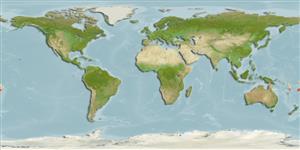
Central Pacific: Fiji.
Tamaño / Peso / Edad
Madurez: Lm ? range ? - ? cm
Max length : 5.3 cm SL (female)
Descripción breve
Claves de identificación | Morfología | Morfometría
Radios blandos dorsales (total) : 64 - 70; Radios blandos anales: 44 - 49; Vértebra: 39 - 41. This species is characterized by the following: vertebrae 11-12 + 27-29 = 39-41, dorsal fin rays 64-70, anal fin rays 44-49; body with scales; eye 1.8-2.6 % SL, sharp spine on ventral maxilla positioned behind rear tip of eye; otolith with pointed posterior tip and weak postdorsal angle, it is elongate, length to height ratio 2.1-2.2, sulcus with separated colliculi (Ref. 57886); large, broad single pair of (outer) pseudoclaspers, inwardly connected to isthmus with ligament, and has 2 supporters, the anterior inclined, short, joined at base to massive and long posterior supporter (Ref. 76869).
Body shape (shape guide): elongated.
Ciclo vital y comportamiento de apareamiento
Madurez | Reproducción | Puesta | Huevos | Fecundidad | Larva
Møller, P.R. and W. Schwarzhans, 2006. Review of the Dinematichthyini (Teleostei, Bythitidae) of the Indo-west Pacific, Part II. Dermatopsis, Dermatopsoides and Dipulus with description of six new species. The Beagle 22:39-76. (Ref. 57886)
Situación en la Lista Roja de la UICN (Ref. 130435: Version 2025-2 (Global))
Amenaza para el ser humano
Harmless
Usos humanos
Herramientas
Informes especiales
Descargar XML
Fuentes de Internet
Estimaciones basadas en modelos
Temperatura preferida (Referencia
123201): 26.8 - 29.3, mean 28 °C (based on 247 cells).
Índice de diversidad filogenética (Referencia
82804): PD
50 = 0.5312 [Uniqueness, from 0.5 = low to 2.0 = high].
Bayesian length-weight: a=0.00389 (0.00180 - 0.00842), b=3.12 (2.94 - 3.30), in cm total length, based on all LWR estimates for this body shape (Ref.
93245).
Nivel trófico (Referencia
69278): 3.2 ±0.5 se; based on size and trophs of closest relatives
Vulnerabilidad pesquera (Ref.
59153): Low vulnerability (10 of 100).
🛈