>
Ovalentaria/misc (Various families in series Ovalentaria) >
Pseudochromidae (Dottybacks) > Pseudoplesiopinae
Etymology: Chlidichthys: Greek, chlidos, -eos, ous = collar, bracelet, adornment + Greek, ichthys = fish (Ref. 45335); clibanarius: The specific epithet alludes to the armourlike appearance of the body, owing to the presence of dark scale edging (Ref. 57771).
More on authors: Gill & Edwards.
Lingkungan: lingkungan / zona iklim / kisaran kedalaman / jangkauan distribusi
Ekologi
laut berasosiasi dengan karang; kisaran kedalaman 0 - 18 m (Ref. 57771). Tropical
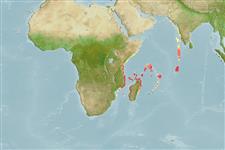
Western Indian Ocean: known only from the Comoros, Aldabra (Seychelles), and
northern Madagascar.
Ukuran / Berat / umur
Kematangan: Lm ? range ? - ? cm
Max length : 4.2 cm SL jantan/; (Ref. 57771)
deskripsi pendek
Kunci identifiaksi (pengenalan) | Morfologi | Morfometrik
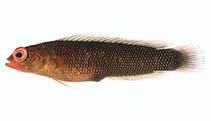
Duri punggung (Keseluruhan (total)) : 2; duri punggung lunak (Keseluruhan (total)) : 22 - 24; Duri dubur: 3; Sirip dubur lunak: 13 - 14. Dorsal fin rays II, 22-24 (usually II, 23); anal fin rays III, 13-14 (usually III, 14); pectoral fin rays 16-18 (usually 17-18); predorsal scales 12-17, extending to interorbital commissure; ctenoid scales beginning at 1-3 transverse scale rows behind gill opening; and circumpeduncle scales 20-23, usually 20. It also has distinctive live and preserved coloration: head and body pale brown to brown (in life, pale green to olive or bright green, with yellow to bright orange or bright red stripes on head and front of body, and snout and anteroventral part of head reddish grey to bright red), with bases of scales edged with dark brown (dark olive-grey in life), giving reticulate pattern; dorsal and anal fins dark brown to dark grey basally (bluish grey to olive in life), greyish to brownish hyaline distally; scaly sheath of caudal fin similar to body coloration, edged posteriorly with dark brown to grey (olive-grey in life), remainder of fin greyish to brownish hyaline (Ref. 57771).
Collected from patch reefs, bommies and caves in drop-offs (Ref. 57771).
Siklus hidup dan perilaku kawin
Kematangan | Reproduksi, perkembang biakan | Pemijahan | telur-telur | Fekunditas | Larva
Gill, A.C. and A.J. Edwards, 2004. Revision of the Indian Ocean dottyback fish genera Chlidichthys and Pectinochromis (Perciformes: Pseudochromidae: Pseudoplesiopinae). Smithiana Bull. 3:1-52. (Ref. 57771)
Status IUCN Red List (Ref. 130435: Version 2025-2 (Global))
ancaman kepada manusia
Harmless
penggunaan manusia
Alat, peralatan
laporan khas
muat turun XML
Sumber internet
Estimasi berdasarkan model
Suhu yang disukai (Acuan
123201): 26.8 - 28.9, mean 27.6 °C (based on 169 cells).
Indeks keanekaragaman filogenetik (Acuan
82804): PD
50 = 0.5001 [Uniqueness, from 0.5 = low to 2.0 = high].
Bayesian length-weight: a=0.00447 (0.00171 - 0.01168), b=3.10 (2.87 - 3.33), in cm total length, based on LWR estimates for this (Sub)family-body shape (Ref.
93245).
Tingkat Trofik (Acuan
69278): 3.3 ±0.5 se; based on size and trophs of closest relatives
Kerentanan Penangkapan Ikan (Ref.
59153): Low vulnerability (10 of 100).
🛈