Classificatie / Namen
Lokale namen | Synoniemen | Catalog of Fishes(Genus, Soort(en)) | ITIS | CoL | WoRMS | Cloffa
>
Blenniiformes (Blennies) >
Tripterygiidae (Triplefin blennies) > Tripterygiinae
Etymology: Enneapterygius: Greek, ennea = nine times + Greek, pterygion = little fin (Ref. 45335); kosiensis: Named after Kosi Bay, the area off which specimens were first found (Ref. 57774).
Milieu: milieu / Klimaatzone / Diepte / verspreidingsgebied
Ecologie
marien rifbewoner; diepte 1 - 30 m (Ref. 57774). Tropical
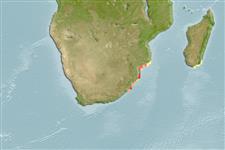
Western Indian Ocean: currently known only from northern KwaZulu-Natal, South Africa.
Grootte / Gewicht / Leeftijd
Maturiteit: Lm ? range ? - ? cm
Max length : 1.9 cm SL mannelijk / geslacht onbekend; (Ref. 57774)
Korte beschrijving
Determinatiesleutels | Morfologie | Morfometrie
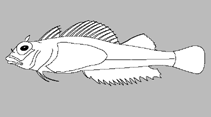
Dorsale stekels (totaal) : 15; Dorsale zachte stralen (totaal) : 9; Anale stekels: 1; Anale zachte stralen: 16 - 17. Dorsal fins III+XII+9; anal fin I,16-17 (usually 17 rays); pectoral fins 13, all rays simple; lateral
line with 12 pored scales and 21-22 notched scales, notched segment starting second scale row below end of pored segment, overlapping by one scale. Total lateral scales 32; transverse scales 1/4. Vertebrae 10+22. Mandibular pores 2+1/2+2. Head 3.2-3.5, body depth 5.1-5.3 in SL; eye 3.1-3.7 in head length; maxilla 2.6-2.9 in head length. Small fish, less than 20 mm SL. Body slender; scales large; nape scaled; belly with smaller, thin cycloid scales. Pelvic fins slender, rays united by a thin, fragile membrane for about one third length of shorter ray. First dorsal fin slightly higher than second, second 75-90% of body depth. Longest pectoral-fin ray reaches nearly to base of first ray of third dorsal fin. Supratemporal sensory
canal crescent-shaped. Mouth oblique, reaching vertical through anterior margin of pupil; interorbital concave and broad, about equal to pupil diameter; orbital cirrus a simple rounded flap and about half pupil diameter in length (Ref. 57774).
Collected from a flat reef (Ref. 57774). Female members of the Tripterygiidae have eggs that are hemispherical and covered with numerous sticky threads that anchor them in the algae on the nesting sites (Ref. 240). Larvae are planktonic which occur primarily in shallow, nearshore waters (Ref. 94114).
Levenscyclus en paargedrag
Maturiteit | Voortplanting | Paaien | Eieren | Fecunditeit | Larven
Holleman, W., 2005. A review of the triplefin fish genus Enneapterygius (Blennioidei: Tripterygidae) in the western Indian Ocean, with descriptions of four new species. Smithiana, Bull. 5:1-25. (Ref. 57774)
Status op de Rode Lijst van het IUCN (Ref. 130435: Version 2025-2 (Global))
Gevaar voor de mens
Harmless
Gebruik door de mens
Visserij: van geen belang
Tools
Speciale rapporten
Download XML
Internetbronnen
Schattingen op basis van modellen
Gewenste temperatuur (Ref.
123201): 23.6 - 25.4, mean 24.9 °C (based on 40 cells).
Fylogenetische diversiteitsindex (Ref.
82804): PD
50 = 0.5000 [Uniqueness, from 0.5 = low to 2.0 = high].
Bayesian length-weight: a=0.00617 (0.00290 - 0.01310), b=3.04 (2.86 - 3.22), in cm total length, based on LWR estimates for this (Sub)family-body shape (Ref.
93245).
Trofisch niveau (Ref.
69278): 3.0 ±0.3 se; based on size and trophs of closest relatives
Weerstandsvermogen (Ref.
120179): Hoog, minimale populatieverdubbelingstijd minder dan 15 maanden (Preliminary K or Fecundity.).
Kwetsbaarheid van de visserij (Ref.
59153): Low vulnerability (10 of 100).
🛈