Klassifizierung / Names
Namen | Synonyme | Catalog of Fishes(Gattung, Arten) | ITIS | CoL | WoRMS | Cloffa
>
Blenniiformes (Blennies) >
Tripterygiidae (Triplefin blennies) > Tripterygiinae
Etymology: Enneapterygius: Greek, ennea = nine times + Greek, pterygion = little fin (Ref. 45335); gruschkai: Named for Victor Gruschka Springer, doyen of blennioid systematics (Ref. 57774).
Eponymy: Dr Victor Gruschka Springer (d: 1928) is a marine biologist and zoologist who is Senior Scientist emeritus, Division of Fishes at the Smithsonian, NMNH. [...] (Ref. 128868), visit book page.
Umwelt: Milieu / Klimazone / Tiefenbereich / Verbreitungsgebiet
Ökologie
seewasser demersal; tiefenbereich 1 - 8 m (Ref. 57774). Tropical
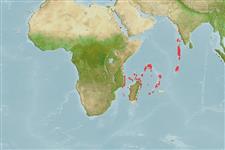
Western Indian Ocean: appears to be restricted to the islands of the western and central Indian Ocean.
Größe / Gewicht / Alter
Geschlechtsreife: Lm ? range ? - ? cm
Max length : 2.9 cm SL Männchen/unbestimmt; (Ref. 57774)
Kurzbeschreibung
Bestimmungsschlüssel | Morphologie | Morphometrie
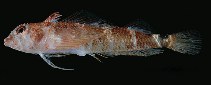
Rückenflossenstacheln (insgesamt) : 15 - 16; Rückenflossenweichstrahlen (insgesamt) : 8 - 11; Afterflossenstacheln: 1; Afterflossenweichstrahlen: 17 - 19. Dorsal fin III+XII-XIII+8-11 (usually III+XIII+9-10); anal fin I,17-19 (usually 18-19 rays); pectoral fins 15: 2+7+6 (occasionally 3+6+6); lateral line with 14-16 (usually 15) pored scales and 19-23 (usually 20-21) notched scales, notched segment starting next scale row below end of pored segment, below mid-second dorsal fin. Total lateral scales 33; transverse scales 3/5. Vertebrae 10+25. Mandibular pores 3+2+3. Head length 3.1-3.6, body depth 5.4-5.9 in SL;
eye 2.7-3.2 in head length. A medium-sized species of Enneapterygius (less than 30 mm SL). Nape scaled, body scales continuing to bases of dorsal and anal fins; belly naked. Pelvic-fin rays not united by membrane. First dorsal fin equal in height to second, second about 70% of body depth. Simple, lobate orbital and anterior nasal cirri present. Supratemporal sensory canal slightly curved. Tongue triangular and sharply pointed; maxilla reaches vertical through
anterior margin of pupil; broad band of teeth in upper and front of lower jaw; palatines without teeth. Spines of first dorsal fin with small, laterally projecting spinelets (Ref. 57774).
Female members of the Tripterygiidae have eggs that are hemispherical and covered with numerous sticky threads that anchor them in the algae on the nesting sites (Ref. 240). Larvae are planktonic which occur primarily in shallow, nearshore waters (Ref. 94114).
Lebenszyklus und Paarungsverhalten
Geschlechtsreife | Fortpflanzung | Ablaichen | Eier | Fruchtbarkeit | Larven
Holleman, W., 2005. A review of the triplefin fish genus Enneapterygius (Blennioidei: Tripterygidae) in the western Indian Ocean, with descriptions of four new species. Smithiana, Bull. 5:1-25. (Ref. 57774)
IUCN Rote Liste Status (Ref. 130435: Version 2025-2 (Global))
Bedrohung für Menschen
Harmless
Nutzung durch Menschen
Fischereien: nicht kommerziell
Tools
Zusatzinformationen
Download XML
Internet Quellen
Schätzungen auf der Grundlage von Modellen
Bevorzugte Temperatur (Ref.
123201): 25.5 - 29, mean 27.5 °C (based on 120 cells).
Phylogenetischer Diversitätsindex (Ref.
82804): PD
50 = 0.5000 [Uniqueness, from 0.5 = low to 2.0 = high].
Bayesian length-weight: a=0.00617 (0.00290 - 0.01310), b=3.04 (2.86 - 3.22), in cm total length, based on LWR estimates for this (Sub)family-body shape (Ref.
93245).
Trophische Ebene (Ref.
69278): 3.1 ±0.3 se; based on size and trophs of closest relatives
Widerstandsfähigkeit (Ref.
120179): hoch, Verdopplung der Population dauert weniger als 15 Monate. (Preliminary K or Fecundity.).
Anfälligkeit der Fischerei (Ref.
59153): Low vulnerability (10 of 100).
🛈