Classificazione / Nomi
Nomi Comuni | Sinonimi | Catalog of Fishes(Genere, Specie) | ITIS | CoL | WoRMS | Cloffa
>
Blenniiformes (Blennies) >
Tripterygiidae (Triplefin blennies) > Tripterygiinae
Etymology: Enneapterygius: Greek, ennea = nine times + Greek, pterygion = little fin (Ref. 45335); genamaculatus: Species name from the Latin 'gena', a cheek, and 'macula', a spot, referring to the spots on the cheeks of the males of the species (Ref. 57774).
Ambiente: milieu / zona climatica / distribuzione batimetrica / gamma di distribuzione
Ecologia
marino demersale. Tropical
Western Indian Ocean: known only from St. Brandon Shoals.
Dimensione / Peso / Età
Maturità: Lm ? range ? - ? cm
Max length : 2.3 cm SL maschio/sesso non determinato; (Ref. 57774)
Breve descrizione
Chiavi di identificazione | Morfologia | Morfometria
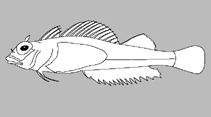
Spine dorsali (totale) : 15 - 16; Raggi dorsali molli (totale) : 9 - 11; Spine anali: 1; Raggi anali molli: 18 - 19. Dorsal fins III+XII-XIII+9-11 (usually III+XIII+10); anal fin I,18-19 (usually 19 rays); pectoral fins 15-16: 3-4+5-6+7-8. Lateral line with 13-15 pored and 21-23 notched scales, notched segment starting one scale row below end of pored segment. Total lateral scales 32-33; transverse scales 2/4. Vertebrae 10+24. Mandibular pores 3+1+3. Head length 3.5-3.9, body depth 4.6-5.4 in SL; eye 2.7-3.1 in head length. Small (less than 25 mm SL), slender fishes; nape scaled, belly naked. Pelvic-fin rays united by membrane for entire length of shorter ray, longer ray reaching anal fin spine. First dorsal fin lower than second; maximum height of second dorsal fin about 70% of body depth. Supratemporal sensory canal crescent-shaped. Orbital cirrus small and rounded. Tip of tongue narrow and rounded; palatines with teeth; maxilla reaching vertical through anterior margin of pupil (Ref. 57774).
Female members of the Tripterygiidae family have eggs that are hemispherical and covered with numerous sticky threads that anchor them in the algae on the nesting sites (Ref. 240). Larvae are planktonic which occur primarily in shallow, nearshore waters (Ref. 94114).
Ciclo vitale e comportamento di accoppiamento
Maturità | Riproduzione | Deposizione | Uova | Fecondità | Larve
Holleman, W., 2005. A review of the triplefin fish genus Enneapterygius (Blennioidei: Tripterygidae) in the western Indian Ocean, with descriptions of four new species. Smithiana, Bull. 5:1-25. (Ref. 57774)
Stato della Lista Rossa IUCN (Ref. 130435: Version 2025-2 (Global))
Minaccia per l'uomo
Harmless
Usi umani
Pesca: di nessun interesse
Strumenti
Rapporti speciali
Scarica XML
Fonti Internet
Stime basate su modelli
Indice di diversità filogenetica (Fonte Biblio.
82804): PD
50 = 0.5000 [Uniqueness, from 0.5 = low to 2.0 = high].
Bayesian length-weight: a=0.00617 (0.00290 - 0.01310), b=3.04 (2.86 - 3.22), in cm total length, based on LWR estimates for this (Sub)family-body shape (Ref.
93245).
Livello trofico (Fonte Biblio.
69278): 3.1 ±0.3 se; based on size and trophs of closest relatives
Resilienza (Fonte Biblio.
120179): Alto, tempo minimo di raddoppiamento della popolazione meno di 15 mesi (Preliminary K or Fecundity.).
Vulnerabilità della pesca (Ref.
59153): Low vulnerability (10 of 100).
🛈