>
Pleuronectiformes (Flatfishes) >
Bothidae (Lefteye flounders)
Etymology: Asterorhombus: Greek, aster = star + Greek, rhombos = paralelogram (Ref. 45335); filifer: Name from Latin, 'filum' for filament and 'fero' for carry, referring to the long first dorsal-fin ray, as it appears in small specimens and when the membrane is furled around the ray.
More on authors: Hensley & Randall.
Milieu: milieu / Klimaatzone / Diepte / verspreidingsgebied
Ecologie
marien rifbewoner; diepte 3 - 57 m (Ref. 57759). Tropical
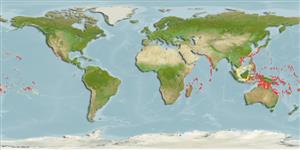
Indo-Pacific: South Africa to Hawaii.
Grootte / Gewicht / Leeftijd
Maturiteit: Lm ? range ? - ? cm
Max length : 10.5 cm SL (female)
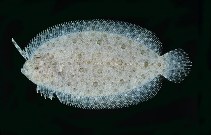
Dorsale zachte stralen (totaal) : 81 - 88; Anale zachte stralen: 63 - 69. This species is distinguished by the following combination of characters: palmate gill-rakers; uniserial dentition in both jaws; first dorsal-fin ray separated from remainder of fin, elongate, 0.8-1.7 in head length (HL), posterior membrane on ray broad, with a smooth margin, and running nearly entire length of ray; eyes usually with one tentacle, frequently branched; sexual dimorphism in interorbital width in specimens larger than ca. 60 mm SL, 8.9-18 in HL (1.6-3.1 % SL) in males, 15-21.2 (0.9-2.3 % SL) in females; body depth 2.0-2.5 in SL (40.4-50.1 SL); lateral line scales 56-67 (Ref. 57773).
Body shape (shape guide): short and / or deep.
Found near reefs, in gullies, or cave entrances on sand or coral- or rock-rubble bottoms at 3-57 m depth (Ref. 57759). Benthic (Ref. 58302). Feeds on small fishes and crustaceans (Ref. 89972).
Levenscyclus en paargedrag
Maturiteit | Voortplanting | Paaien | Eieren | Fecunditeit | Larven
Hensley, D.A., 2005. Revision of the genus Asterorhombus (Pleuronectiformes: Bothidae). Copeia 2005(3):445-460. (Ref. 57759)
Status op de Rode Lijst van het IUCN (Ref. 130435: Version 2025-2 (Global))
Gevaar voor de mens
Harmless
Gebruik door de mens
Tools
Speciale rapporten
Download XML
Internetbronnen
Schattingen op basis van modellen
Gewenste temperatuur (Ref.
123201): 24.5 - 28.9, mean 27.4 °C (based on 378 cells).
Fylogenetische diversiteitsindex (Ref.
82804): PD
50 = 0.6250 [Uniqueness, from 0.5 = low to 2.0 = high].
Bayesian length-weight: a=0.00912 (0.00412 - 0.02018), b=3.05 (2.87 - 3.23), in cm total length, based on LWR estimates for this (Sub)family-body shape (Ref.
93245).
Trofisch niveau (Ref.
69278): 3.5 ±0.4 se; based on size and trophs of closest relatives
Weerstandsvermogen (Ref.
120179): Gemiddeld, minimale populatieverdubbelingstijd 1,4-4,4 jaar (Preliminary K or Fecundity.).
Kwetsbaarheid van de visserij (Ref.
59153): Low vulnerability (10 of 100).
🛈