Klassifizierung / Names
Namen | Synonyme | Catalog of Fishes(Gattung, Arten) | ITIS | CoL | WoRMS | Cloffa
>
Pleuronectiformes (Flatfishes) >
Soleidae (Soles)
Etymology: Aseraggodes: Greek, aggos, -eos, -ous = vessel, uterus, carapace of a crab + Greek, aseros, -a, -on = to remove the appetite (Ref. 45335); heemstrai: Named for Phillip Heemstra.
Eponymy: Dr Phillip Clarence Heemstra (1941–2019) was an American/South African marine ichthyologist and scientific diver. [...] (Ref. 128868), visit book page.
More on authors: Randall & Gon.
Umwelt: Milieu / Klimazone / Tiefenbereich / Verbreitungsgebiet
Ökologie
seewasser riff-verbunden; tiefenbereich 15 - 39 m (Ref. 57561). Tropical; 27°S - 31°S (Ref. 57561)
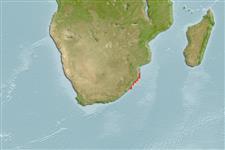
Western Indian Ocean: South Africa.
Größe / Gewicht / Alter
Geschlechtsreife: Lm ? range ? - ? cm
Max length : 8.7 cm SL Männchen/unbestimmt; (Ref. 57561)
Kurzbeschreibung
Bestimmungsschlüssel | Morphologie | Morphometrie
Rückenflossenweichstrahlen (insgesamt) : 68 - 75; Afterflossenweichstrahlen: 48 - 52; Wirbelzahl: 36 - 38. DIAGNOSIS: Dorsal rays 68-75; anal rays 48-52; dorsal and anal rays branched except for a few anterior rays; lateral-line scales 70-78, including 9 or 10 anterior to a vertical at upper
end of gill opening; lateral line on ocular side projecting toward dorsal part of upper
eye; vertebrae 36-38; dorsal pterygiophores anterior to fourth neural spine 11-13; body
depth 2.4-2.45 in SL; head length (HL) 4.05-4.35 in SL; snout length 2.65-2.95 in HL; eye diameter 4.6-5.05 in HL; interorbital space very narrow, the least vertical width 26-33 in HL; tubular anterior nostril nearly reaching eyeball when laid back; cirri on front of snout and ventral side of head small and slender; no cirri on opercle at edge of gill opening, and none along edge of membranous ridges of dorsal and anal rays; caudal peduncle present but very short, the length 10.2-17.7 in HL; caudal-peduncle depth 1.7-1.95 in HL; longest dorsal ray 1.65-1.8
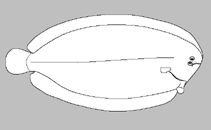
in HL; caudal-fin length 4.2-4.7 in SL; pelvic-fin length 1.75-2.0 in HL, reaching base third anal ray; color of ocular side when fresh brown, the edges of scales darker brown, with numerous irregular dark-edged white spots, the largest (most smaller than eye) in three rows, one below dorsal .n, one above anal .n, and one along lateral line, where most irregular; scattered small blackish spots, some specimens with indistinct larger blackish blotches alternating with large white spots of the three rows; fin rays with small brown and larger white spots, the membranes translucent. Color in alcohol with white spots, faint to absent and dark spots subdued (Ref. 57561).
Body shape (shape guide): short and / or deep.
Lebenszyklus und Paarungsverhalten
Geschlechtsreife | Fortpflanzung | Ablaichen | Eier | Fruchtbarkeit | Larven
Randall, J.E. and O. Gon, 2006. Review of the soles of the genus Aseraggodes of the Western Indian Ocean, with descrtiptions of three new species. Israel J. Zool. 51:165-190. (Ref. 57561)
IUCN Rote Liste Status (Ref. 130435: Version 2025-2 (Global))
Bedrohung für Menschen
Harmless
Nutzung durch Menschen
Tools
Zusatzinformationen
Download XML
Internet Quellen
Schätzungen auf der Grundlage von Modellen
Bevorzugte Temperatur (Ref.
123201): 22.5 - 24.3, mean 23.9 °C (based on 8 cells).
Phylogenetischer Diversitätsindex (Ref.
82804): PD
50 = 0.5000 [Uniqueness, from 0.5 = low to 2.0 = high].
Bayesian length-weight: a=0.00955 (0.00454 - 0.02011), b=3.07 (2.90 - 3.24), in cm total length, based on LWR estimates for this (Sub)family-body shape (Ref.
93245).
Trophische Ebene (Ref.
69278): 3.5 ±0.5 se; based on size and trophs of closest relatives
Widerstandsfähigkeit (Ref.
120179): hoch, Verdopplung der Population dauert weniger als 15 Monate. (Preliminary K or Fecundity.).
Anfälligkeit der Fischerei (Ref.
59153): Low vulnerability (10 of 100).
🛈