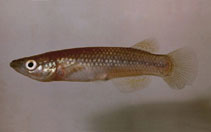
Classificazione / Nomi
Nomi Comuni | Sinonimi | Catalog of Fishes(Genere, Specie) | ITIS | CoL | WoRMS | Cloffa
>
Cyprinodontiformes (Rivulines, killifishes and live bearers) >
Aplocheilidae (Killifishes)
Etymology: Pachypanchax: Greek, pachys = fat + Panchax, a word created by Meinken in 1932 word created by Meinken in 1932; varatraza: Named for the Malagasy word varatraza, meaning east wind, in acknowledgement of the unanticipated presence of a Pachypanchax species in rivers draining the eastern slope of The Tsaratanana Massif (Ref. 57724).
Ambiente: milieu / zona climatica / distribuzione batimetrica / gamma di distribuzione
Ecologia
; acqua dolce benthopelagico. Tropical
Africa: Menambery, Fanambana and Ampanobe river basins in Madagascar (Ref. 57724).
Dimensione / Peso / Età
Maturità: Lm ? range ? - ? cm
Max length : 6.8 cm SL maschio/sesso non determinato; (Ref. 57724)
Breve descrizione
Chiavi di identificazione | Morfologia | Morfometria
Raggi dorsali molli (totale) : 11 - 13; Raggi anali molli: 17 - 19. Distinguished from Pachypanchax playfairii in lacking raised dorsolateral squamation and in details of its color pattern. Males without rows of discrete red dots on the flanks and red edging to the vertical fins; female lack any sort of black markings on the dorsal fin. Has the shortest pectoral fins (13.4% SL) among Malagasy Pachypanchax. Differs from Pachypanchax sakaramyi and Pachypanchax sparksorum by the absence of pectoral scales of reduced size. Can be distinguished from Pachypanchax omalonotus by the rounded dorsal and anal fins of males and their lack of discrete metallic gold spangling on the flanks; and also differs from the remaining Malagasy congeners by lack of iridescent white edging to, or darker submarginal banding on, the vertical fins (Ref. 57724).
Found in a wide range of habits: stream flowing under relatively intact forest cover at an altitude of 70 m above sea level consisting of a series of quiet pools with clay/sand bottoms, interspersed with short stretches of flowing water over sand/ gravel bottoms and with very turbid water; and stream flowing through modified low-altitude rain forest at an altitude of 30 m above sea level consisting of clay/sand bottom, interspersed with patches of bedrock with clear water and moderate current (Ref. 57724). Feeds on terrestrial and aquatic insects (Ref. 57724).
Ciclo vitale e comportamento di accoppiamento
Maturità | Riproduzione | Deposizione | Uova | Fecondità | Larve
Loiselle, P.V., 2006. A review of the Malagasy Pachypanchax (Teleostei: Cyprinodontiformes, Aplocheilidae), with descriptions of four new species. Zootaxa 1366:1-44. (Ref. 57724)
Stato della Lista Rossa IUCN (Ref. 130435: Version 2025-2 (Global))
Minaccia per l'uomo
Harmless
Usi umani
Strumenti
Rapporti speciali
Scarica XML
Fonti Internet
Stime basate su modelli
Indice di diversità filogenetica (Fonte Biblio.
82804): PD
50 = 0.5079 [Uniqueness, from 0.5 = low to 2.0 = high].
Bayesian length-weight: a=0.00389 (0.00180 - 0.00842), b=3.12 (2.94 - 3.30), in cm total length, based on all LWR estimates for this body shape (Ref.
93245).
Livello trofico (Fonte Biblio.
69278): 3.6 ±0.5 se; based on size and trophs of closest relatives
Vulnerabilità della pesca (Ref.
59153): Low vulnerability (10 of 100).
🛈