Environnement : milieu / zone climatique / profondeur / gamme de distribution
Écologie
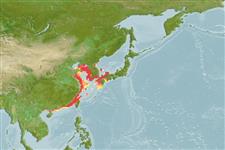
marin; eau douce; saumâtre pelagic-neritic; anadrome (Ref. 51243); profondeur 0 - 50 m (Ref. 189). Subtropical; 42°N - 21°N, 109°E - 134°E (Ref. 189)
Northwest Pacific: Canton north to Ariake Sound, southwestern Japan, including all of Yellow Sea and off western coasts of Korea. Penetrates over 1000 km up the Yangtze River.
Longueur à la première maturité / Taille / Poids / Âge
Maturité: Lm ?, range 24 - 27 cm
Max length : 41.0 cm TL mâle / non sexé; (Ref. 189)
Description synthétique
Clés d'identification | Morphologie | Morphométrie
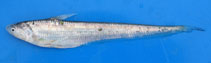
Épines dorsales (Total) : 0; Épines anales: 0; Rayons mous anaux: 80. Body tapering, belly rounded before pelvic fins, with 16 to 26 + 25 to 36 = 43 to 61 keeled scutes from isthmus to anus. Maxilla long, reaching to or almost to base of first pectoral fin ray. Pectoral fin with 6 filaments; branched fin rays longer than those of pelvic fin.
Body shape (shape guide): elongated; Cross section: compressed.
Occurs in coastal waters, estuaries and reaching up to middle parts of rivers, apparently able to tolerate freshwater (Ref. 189, 11230). Lives in not really clean water but not really turbid water either (Ref. 12218). Goes to the deep water areas of rivers at night (Ref. 12218). Planktivore (Ref. 12218). Spawns around three times in a lifetime and spawning occurs in between reeds (Ref. 12218). In Ariake Sound, Japan it breeds from May to August, the fishes running about 15 km up the Chikugo River and spawning in freshwater, the spherical eggs floating down and hatching near the river mouth. Its relatively large size makes it a more esteemed food fish than most Coilia. Used in Chinese medicine (Ref. 12166).
Spawn in school (Ref. 205).
Whitehead, P.J.P., G.J. Nelson and T. Wongratana, 1988. FAO Species Catalogue. Vol. 7. Clupeoid fishes of the world (Suborder Clupeoidei). An annotated and illustrated catalogue of the herrings, sardines, pilchards, sprats, shads, anchovies and wolf-herrings. FAO Fish. Synop. 125(7/2):305-579. Rome: FAO. (Ref. 189)
Statut dans la liste rouge de l'IUCN (Ref. 130435: Version 2025-2 (Global))
Menace pour l'homme
Harmless
Utilisations par l'homme
Pêcheries: commercial
Outils
Articles particuliers
Télécharger en XML
Sources Internet
Estimations basées sur des modèles
Température préférée (Réf.
123201): 12.3 - 25.2, mean 17.5 °C (based on 218 cells).
Indice de diversité phylogénétique (Réf.
82804): PD
50 = 0.5001 [Uniqueness, from 0.5 = low to 2.0 = high].
Bayesian length-weight: a=0.00251 (0.00190 - 0.00332), b=3.07 (3.02 - 3.12), in cm total length, based on LWR estimates for this species (Ref.
93245).
Niveau trophique (Réf.
69278): 3.0 ±0.00 se; based on food items.
Generation time: 3.1 ( na - na) years. Estimated as median ln(3)/K based on 2
growth studies.
Résilience (Réf.
120179): Milieu, temps minimum de doublement de population : 1,4 à 4,4 années (K=0.35; tmax=5).
Vulnérabilité de la pêche (Ref.
59153): Low to moderate vulnerability (25 of 100).
🛈