Classificatie / Namen
Lokale namen | Synoniemen | Catalog of Fishes(Genus, Soort(en)) | ITIS | CoL | WoRMS | Cloffa
>
Cichliformes (Cichlids, convict blennies) >
Cichlidae (Cichlids) > Geophaginae
Etymology: Guianacara: Composed from Guyana + Tupí, guaraní, acará = the name of a fish (Ref. 45335); cuyunii: Named for the Cuyuní River; noun in apposition.
Eponymy: This is a toponym referring to the Cuyuní River, Bolívar, Venezuela; the type locality. (Ref. 128868), visit book page.
More on authors: López-Fernández, Taphorn & BaechleKullander.
Milieu: milieu / Klimaatzone / Diepte / verspreidingsgebied
Ecologie
; zoet water pelagisch. Tropical
South America: Venezuela.
Grootte / Gewicht / Leeftijd
Maturiteit: Lm ? range ? - ? cm
Max length : 7.5 cm SL mannelijk / geslacht onbekend; (Ref. 57436)
Korte beschrijving
Determinatiesleutels | Morfologie | Morfometrie
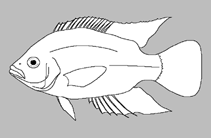
Guianacara cuyunii belongs to the subgenus Guianacara and it differs from G. oelemariensis (subgenus Oelemaria) by having 2 supraneurals instead of one and by possessing a uniformly dark midlateral bar, in contrast with a midlateral spot. It can be distinguished from G. stergiosi, G. geayi and G. sphenozona in having a thinner midlateral bar which is three scales at its widest point, gradually thinning to two scales below the lateral line (vs. midlateral bar four scales at its widest and is never thinned to less than three scales). Adult G. cuyunii retain the black coloration in the membranes of the anterior three dorsal spines (lost in adults of G. sphenozona and G. geayi). It is distinguished from G. owroewefi by its thinner, never faint midlateral bar. Furthermore, G. cuyunii can be distinguished from G. stergiosi, G. owroewefi, and G. sphenozona by having a pectoral fin that does not reach the base of the anal fin and a branchiostegal membrane of background body color instead of dusky (Ref. 57436).
Levenscyclus en paargedrag
Maturiteit | Voortplanting | Paaien | Eieren | Fecunditeit | Larven
López-Fernández, H., D.C. Taphorn Baechle and S. Kullander, 2006. Two new species of Guianacara from the Guiana Shield of Eastern Venezuela (Perciformes: Cichlidae). Copeia 2006(3):384-395. (Ref. 57436)
Status op de Rode Lijst van het IUCN (Ref. 130435: Version 2025-2 (Global))
Gevaar voor de mens
Harmless
Gebruik door de mens
Tools
Speciale rapporten
Download XML
Internetbronnen
Schattingen op basis van modellen
Fylogenetische diversiteitsindex (Ref.
82804): PD
50 = 0.5078 [Uniqueness, from 0.5 = low to 2.0 = high].
Bayesian length-weight: a=0.02399 (0.01144 - 0.05029), b=3.01 (2.83 - 3.19), in cm total length, based on LWR estimates for this (Sub)family-body shape (Ref.
93245).
Trofisch niveau (Ref.
69278): 3.3 ±0.5 se; based on size and trophs of closest relatives
Weerstandsvermogen (Ref.
120179): Hoog, minimale populatieverdubbelingstijd minder dan 15 maanden (Preliminary K or Fecundity.).
Kwetsbaarheid van de visserij (Ref.
59153): Low vulnerability (10 of 100).
🛈