Klassificering / Namn
Populärnamn | synonymer | Catalog of Fishes(Släkte, Arter) | ITIS | CoL | WoRMS | Cloffa
>
Siluriformes (Catfishes) >
Loricariidae (Armored catfishes) > Hypostominae
Etymology: Chaetostoma: Greek, chaite = hair + Greek, stoma = mouth (Ref. 45335); changae: Named for Fonchii Chang (1963-1999).
Eponymy: Fonchii Ingrid Chang Matzunaga (1963–1999) was a Peruvian ichthyologist of both Japanese and Chinese ancestry. [...] (Ref. 128868), visit book page.
Miljö: miljö / Klimatzon / djupintervall / distributionsområde
Ekologi
; sötvatten bottenlevande. Tropical
South America: Peru.
Storlek / Vikt / Ålder
Könsmognad: Lm ? range ? - ? cm
Max length : 7.6 cm SL hane/ej könsbestämd; (Ref. 56969)
Kort beskrivning
Bestämningsnycklar | Morfologi | Morfometri
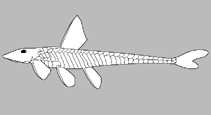
Diagnosis: Distinguished from its congeners by the conspicuously banded dorsal fin; presence of fleshy excrescence on posterior tip of supraoccipital; typically 9 branched dorsal-fin rays (rarely 8 or 10); and evertible cheek plates with 2-4 hypertrophied odontodes. Chaetostoma changae differs from species described from the same drainage as follows: C. breve has 5-8 and C. dermorhynchum 4-5 hypertrophied odontodes on evertible cheek plates (vs. 2-4); C. carrioni does not have adipose and anal fins (vs. presence); C. dermorhynchum has 5 ramified anal-fin rays (vs. 3-4); C. branickii, C. lineopunctatum, C. loborhynchos, C. marcapatae,
C. marmorescens, C. mollinasum, C. sericeum, and C. taczanowskii have 6 infraorbital plates (vs. 7) and first anal-fin ray with 2 or more rows of odontodes along its anterior border (vs. first anal-fin ray without odontodes); C. greeni, C. marcapatae and C. sericeum have a wide interorbital width: 37.048.0% HL (vs. 28.3-32.4% HL) and numerous hypertrophied odontodes on evertible cheek plates: 7-12 (vs. 2-4); branickii has a reduced triangular sphenotic (vs. square); lineopunctatum has dark spots on body (vs. uniformly pigmented); loborhynchos, marmorescens, mollinasum, taczanowskii exhibit rounded papillae on the naked snout (vs. irregularly shaped papillae) and straight hypertrophied odontodes on evertible cheek plates (vs. hooked); loborhynchos, marmorescens, mollinasum, and taczanowskii
lack the longitudinal fleshy excrescence on the posterior tip of the supraoccipital, a fleshy projection on the middle third on the anterior soft border of dentary, and contact between sixth infraorbital and suprapreopercle (Ref. 56969).
Body shape (shape guide): elongated.
Facultative air-breathing in the genus (Ref. 126274)
Livscykel och parningsbeteende
Könsmognad | Reproduktion | Lek | Ägg | Fekunditet | Larver
Salcedo, N.J., 2006. New species of Chaetostoma (Siluriformes: Loricariidae) from Central Peru. Copeia 2006(1):60-67. (Ref. 56969)
Status på IUCN:s rödlista (Ref. 130435: Version 2025-2 (Global))
Hot mot människor
Harmless
Mänskliga användningsområden
Verktyg
Särskilda rapporter
Ladda ner XML
Internet-källor
Uppskattningar baserade på modeller
Index för fylogenetisk mångfald (Ref.
82804): PD
50 = 0.5000 [Uniqueness, from 0.5 = low to 2.0 = high].
Bayesian length-weight: a=0.01660 (0.00737 - 0.03739), b=2.95 (2.77 - 3.13), in cm total length, based on LWR estimates for this Genus-body shape (Ref.
93245).
Sårbarhet i fisket (Ref.
59153): Low vulnerability (10 of 100).
🛈