Classification / Noms
Noms communs | Synonymes | Catalog of Fishes(Genre, Espèce) | ITIS | CoL | WoRMS | Cloffa
>
Characiformes (Characins) >
Acestrorhamphidae (American tetras) > Acestrorhamphinae
Etymology: Astyanax: The name of Astyanax, Hector´s son in the Greek mythology (Ref. 45335).
Eponymy: Astyanax was the son of Hector in Greek mythology. See Homer’s Iliad for details. The reasoning for its use for a genus of characins is not explained. Raúl Horacio Arámburu (1924–2004) was a researcher and professor of the Museo de La Plata, Buenos Aires. He was the first Professor of Ichthyology in Argentina. This species of fish is endemic to Argentina. (Ref. 128868), visit book page.
Environnement : milieu / zone climatique / profondeur / gamme de distribution
Écologie
; eau douce pélagique; profondeur 2 - ? m (Ref. 57546). Subtropical
South America: Argentina.
Taille / Poids / Âge
Maturité: Lm ? range ? - ? cm
Max length : 6.1 cm SL mâle / non sexé; (Ref. 57546)
Description synthétique
Clés d'identification | Morphologie | Morphométrie
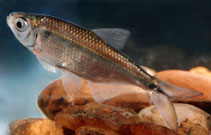
Diagnosis: Distinct from its congeners in having a round or trapezoidal black humeral spot, dorsal to the lateral line; a branch of the infraorbital sensory canal directed ventrally, continued as a series of pores totally or partially traversing the third infraorbital; body relatively slender (31.8-37.4% SL); eye large (41.1-45.8% HL); snout short (15.5-20.9% HL); caudal peduncle relatively slender (10.3-12% SL); one pentacuspid maxillary tooth; pored lateral line scales 38-42; and anal fin rays v-vi, 23-29. The males have breeding tubercles on the head and scales, and bony hooks on all fins (Ref. 57546).
Body shape (shape guide): fusiform / normal.
Collected from a creek which is a relatively extensive watercourse, with sections about 50 m wide and pools over 2 m deep; vegetated with grasses and other plants, and the bottom consists of mud and clay (Ref. 57546).
Cycle de vie et comportement reproducteur
Maturité | Reproduction | Frai | Œufs | Fécondité | Larves
Protogino, L., A.M. Miquelarena and H.L. López, 2006. A new species of Astyanax (Teleostei, Characiformes, Characidae), with breeding tubercles, from Paraná and Uruguay river basins. Zootaxa 1297:1-16. (Ref. 57546)
Statut dans la liste rouge de l'IUCN (Ref. 130435: Version 2025-2 (Global))
Menace pour l'homme
Harmless
Utilisations par l'homme
Pêcheries: sans intérêt
Outils
Articles particuliers
Télécharger en XML
Sources Internet
Estimations basées sur des modèles
Indice de diversité phylogénétique (Réf.
82804): PD
50 = 0.5000 [Uniqueness, from 0.5 = low to 2.0 = high].
Bayesian length-weight: a=0.01047 (0.00452 - 0.02424), b=3.11 (2.93 - 3.29), in cm total length, based on LWR estimates for this Genus-body shape (Ref.
93245).
Niveau trophique (Réf.
69278): 3.0 ±0.4 se; based on size and trophs of closest relatives
Résilience (Réf.
120179): Haut, temps minimum de doublement de population inférieur à 15 mois (Preliminary K or Fecundity.).
Vulnérabilité de la pêche (Ref.
59153): Low vulnerability (10 of 100).
🛈