Klassificering / Namn
Populärnamn | synonymer | Catalog of Fishes(Släkte, Arter) | ITIS | CoL | WoRMS | Cloffa
>
Pleuronectiformes (Flatfishes) >
Soleidae (Soles)
Etymology: Aseraggodes: Greek, aggos, -eos, -ous = vessel, uterus, carapace of a crab + Greek, aseros, -a, -on = to remove the appetite (Ref. 45335); auroculus: Name from the Latin 'aurum' for gold and 'oculus' for eye, referring to the bright golden color of the eyes.
More on author: Randall.
Miljö: miljö / Klimatzon / djupintervall / distributionsområde
Ekologi
marina revassocierade; djupintervall 15 - 24 m (Ref. 57560). Tropical
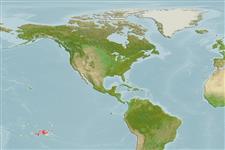
Eastern Central Pacific: Society Islands.
Storlek / Vikt / Ålder
Könsmognad: Lm ? range ? - ? cm
Max length : 3.6 cm SL hane/ej könsbestämd; (Ref. 57560)
Kort beskrivning
Bestämningsnycklar | Morfologi | Morfometri
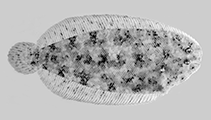
Mjukstrålar i ryggfenan (totalt) : 74 - 77; Mjukstrålar i analfenan: 56 - 57; Ryggkotor: 37 - 38. Diagnosis: Dorsal rays 74-77; anal rays 56-57; most dorsal and anal rays double branched. Lateral-line scales 69-73. including 6-7 anterior to a vertical at upper end of gill opening. Vertebrae 37-38; dorsal pterygiophores anterior to fourth neural spine 12. Body depth 2.45-2.6 in SL; head length (HL) 3.85-3.95 in SL; eye diameter 4.55-4.9 in HL; upper eye overlapping a anterior two-thirds to three-fourths of lower eye; interorbital space narrow, the vertical distance between eyes about one-fourth to one-sixth eye diameter. Caudal peduncle absent. Short fleshy cirri on ventral edge of head. Lateral line aligned with ventral part of upper eye. Longest dorsal ray 1.55-1.7 in HL; caudal fin rounded, 4.4-4.55 in SL in length; pelvic fins 2.4-2.7 in HL, the tip of longest ray reaching base of second or third anal ray. Body color of ocular side in alcohol pale yellowish brown with 3 rows of large irregular blackish blotches, one dorsal, one ventral, and one midlateral; a few small dark spots on fin rays; blind side pale yellowish, the dark spots on rays faint (Ref. 57560).
Body shape (shape guide): short and / or deep.
Collected from steep sloping bottoms dominated by coral rubble (Ref. 57560).
Livscykel och parningsbeteende
Könsmognad | Reproduktion | Lek | Ägg | Fekunditet | Larver
Randall, J.E., 2005. A review of soles of the genus Aseraggodes from the South Pacific, with descriptions of seven new species and a diagnosis of Synclidopus. Memoirs of Museum Victoria 62(2):191-212. (Ref. 57560)
Status på IUCN:s rödlista (Ref. 130435: Version 2025-2 (Global))
Hot mot människor
Harmless
Mänskliga användningsområden
Verktyg
Särskilda rapporter
Ladda ner XML
Internet-källor
Uppskattningar baserade på modeller
Önskad temperatur (Ref.
123201): 26.9 - 29, mean 27.8 °C (based on 99 cells).
Index för fylogenetisk mångfald (Ref.
82804): PD
50 = 0.5000 [Uniqueness, from 0.5 = low to 2.0 = high].
Bayesian length-weight: a=0.00955 (0.00454 - 0.02011), b=3.07 (2.90 - 3.24), in cm total length, based on LWR estimates for this (Sub)family-body shape (Ref.
93245).
Trofisk nivå (Ref.
69278): 3.2 ±0.5 se; based on size and trophs of closest relatives
Resiliens (Ref.
120179): Hög, lägsta populationsfördubblingstid mindre än 15 månader (Preliminary K or Fecundity.).
Sårbarhet i fisket (Ref.
59153): Low vulnerability (10 of 100).
🛈