Classificatie / Namen
Lokale namen | Synoniemen | Catalog of Fishes(Genus, Soort(en)) | ITIS | CoL | WoRMS | Cloffa
>
Gobiiformes (Gobies) >
Gobiidae (Gobies) > Gobiinae
Etymology: Amblyeleotris: Greek, amblys = darkness + The name of a Nile fish, eleotris (Ref. 45335); bellicauda: Name from Latin word 'bellus' meaning beautiful and 'cauda' for tail, referring to the strikingly colorful caudal fin; noun in apposition.
More on author: Randall.
Milieu: milieu / Klimaatzone / Diepte / verspreidingsgebied
Ecologie
marien demersaal; diepte 3 - ? m (Ref. 57552). Tropical
Western Central Pacific: New Caledonia.
Grootte / Gewicht / Leeftijd
Maturiteit: Lm ? range ? - ? cm
Max length : 5.0 cm SL (female)
Korte beschrijving
Determinatiesleutels | Morfologie | Morfometrie
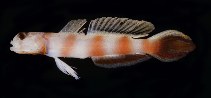
Dorsale stekels (totaal) : 7; Dorsale zachte stralen (totaal) : 13 - 3; Anale stekels: 1 - 11; Anale zachte stralen: 13; Wervels: 25. Diagnosis: Dorsal rays VI-I, 13; anal rays 1, 13; pectoral rays 19; pelvic fins joined by a short membrane at base, with no frenum; fifth pelvic ray branched three times. Longitudinal scale series 89; no median predorsal scales and no prepectoral scales. Gill opening extending forward to below posterior margin of preopercle. Body depth 5.35 in SL; head length 3.55 in SL; mouth not very large, the maxilla reaching to below centre of eye, the upper-jaw length 2.65 in HL; caudal fin slightly pointed and moderately long, 2.9 in SL: fourth pelvic ray longest. Pale yellow dorsally, shading to white ventrally, densely marked with small pale blue spots; four red bars on body, the first slightly oblique beneath first dorsal fin, the next two broader ventrally, below second dorsal fin, and the fourth posteriorly on caudal peduncle and on caudal fin base; head brownish yellow dorsally, white ventrally, with numerous small pale blue spots and a red bar from nape across posterior opercle; an irregular yellow-edged blue line extending ventrally from opercular membrane to branchiostegal membranes; first dorsal fin grey, shading to greyish blue posteriorly, with dark-edged yellow markings; second dorsal fin grey with a dark-edged yellow line parallel to rays on each membrane, the base yellow with dark-edged blue markings; anal fin yellow with irregular dark-edged blue markings and a broad median blackish red band; caudal fin with a large, irregular, elliptical, blue-edged mark enclosing a dusky orange area; upper and lower edges of fin pale yellow with blue spots (Ref. 57552).
Body shape (shape guide): elongated.
Found over coarse sand and lives symbiotically in a burrow with an alpheid shrimp (Ref. 57552). Minimum depth from Ref. 58018.
Levenscyclus en paargedrag
Maturiteit | Voortplanting | Paaien | Eieren | Fecunditeit | Larven
Randall, J.E., 2004. Five new shrimp gobies of the genus Amblyeleotris from islands of Oceania. aqua, J. Ichthyol. Aquat. Biol. 8(2):61-78. (Ref. 57552)
Status op de Rode Lijst van het IUCN (Ref. 130435: Version 2025-2 (Global))
Gevaar voor de mens
Harmless
Gebruik door de mens
Tools
Speciale rapporten
Download XML
Internetbronnen
Schattingen op basis van modellen
Fylogenetische diversiteitsindex (Ref.
82804): PD
50 = 0.5000 [Uniqueness, from 0.5 = low to 2.0 = high].
Bayesian length-weight: a=0.00741 (0.00347 - 0.01582), b=3.09 (2.91 - 3.27), in cm total length, based on LWR estimates for this (Sub)family-body shape (Ref.
93245).
Trofisch niveau (Ref.
69278): 3.2 ±0.3 se; based on size and trophs of closest relatives
Weerstandsvermogen (Ref.
120179): Hoog, minimale populatieverdubbelingstijd minder dan 15 maanden (Preliminary K or Fecundity.).
Kwetsbaarheid van de visserij (Ref.
59153): Low vulnerability (10 of 100).
🛈