Klassifizierung / Names
Namen | Synonyme | Catalog of Fishes(Gattung, Arten) | ITIS | CoL | WoRMS | Cloffa
>
Gymnotiformes (Knifefishes) >
Sternopygidae (Glass knifefishes) > Eigenmanninae
Etymology: Rhabdolichops: Greek, rhabdos = stick + Greek, dolichos = long (Ref. 45335).
Umwelt: Milieu / Klimazone / Tiefenbereich / Verbreitungsgebiet
Ökologie
; süßwasser benthopelagisch; tiefenbereich 5 - 10 m (Ref. 55969). Tropical
South America: Brazil.
Größe / Gewicht / Alter
Geschlechtsreife: Lm ? range ? - ? cm
Max length : 16.1 cm SL Männchen/unbestimmt; (Ref. 55969)
Kurzbeschreibung
Bestimmungsschlüssel | Morphologie | Morphometrie
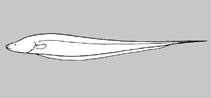
Diagnosis: Distinguished from its congeners by the following unique characters: an unusual electric organ (EO) morphology in which the posterior EO margin ends abruptly and is replaced by rigid and transparent non-electrogenic tissue in the posterior, approximate one-half of the caudal appendage; very visible hemal spines in the posterior half of the caudal appendage; presence of 5 (vs. 6 or 7) pairs of pleural ribs; oral teeth conical, with diameter at base more than at midlength (vs. villiform, about as wide at base as at midlength in all congeners; cleithral posterior process broad (vs. narrow in all congeners). Also, it differs from its congeners, except with R. stewarti, in possessing non-ossified gill rakers, and except R. electrogrammus and R. caviceps, in possessing a distinct "black cap" (dense region of dark chromatophores in the parietal region) (Ref. 55969).
This species is known only from the main channel of the low-nutrient blackwater Rio Tefé. Apparently, the species is a benthic specalist. It is captured in trawl nets where it occurs with Rhabdolichops eastwardi, troscheli, caviceps, nigrimans, and electrogrammus, except lundbergi. Its diet consists of small planktonic crustacean primarily Cladocera and Copepoda, but also small Conchostraca and Ostracoda (Ref. 55969).
Lebenszyklus und Paarungsverhalten
Geschlechtsreife | Fortpflanzung | Ablaichen | Eier | Fruchtbarkeit | Larven
Correa, S.B., W.G.R. Crampton and J.S. Albert, 2006. Three new species of the neotropical electric fish Rhabdolichops (Gymnotiformes: Sternopygidae) from the central Amazon, with a new diagnosis of the genus. Copeia 2006(1):27-42. (Ref. 55969)
IUCN Rote Liste Status (Ref. 130435: Version 2025-2 (Global))
Bedrohung für Menschen
Harmless
Nutzung durch Menschen
Tools
Zusatzinformationen
Download XML
Internet Quellen
Schätzungen auf der Grundlage von Modellen
Phylogenetischer Diversitätsindex (Ref.
82804): PD
50 = 0.5010 [Uniqueness, from 0.5 = low to 2.0 = high].
Bayesian length-weight: a=0.00355 (0.00161 - 0.00782), b=2.97 (2.78 - 3.16), in cm total length, based on LWR estimates for this (Sub)family-body shape (Ref.
93245).
Trophische Ebene (Ref.
69278): 3.2 ±0.31 se; based on food items.
Anfälligkeit der Fischerei (Ref.
59153): Low vulnerability (10 of 100).
🛈