klasifikasi / Nama
Nama-nama umum | Sinonim (persamaan) | Catalog of Fishes(Marga, Jenis) | ITIS | CoL | WoRMS | Cloffa
>
Gymnotiformes (Knifefishes) >
Sternopygidae (Glass knifefishes) > Eigenmanninae
Etymology: Rhabdolichops: Greek, rhabdos = stick + Greek, dolichos = long (Ref. 45335); nigrimans: Name from the Latin noun 'manus', meaning hand, and 'nigrum' for black, referring to the diagnostic black pectoral fin.
Lingkungan: lingkungan / zona iklim / kisaran kedalaman / jangkauan distribusi
Ekologi
; air tawar bentopelagis; kisaran kedalaman 5 - 15 m (Ref. 55969). Tropical
South America: Brazil.
Ukuran / Berat / umur
Kematangan: Lm ? range ? - ? cm
Max length : 43.1 cm TL jantan/; (Ref. 55969); 30.5 cm TL (female)
deskripsi pendek
Kunci identifiaksi (pengenalan) | Morfologi | Morfometrik
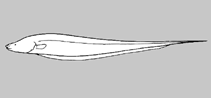
Diagnosis: Distinguished from its congeners by the following characters: presence of black pectoral and anal fins, with dark chromatophores extending to the distal tips of the fin rays, and from all congeners (except R. lundbergi) by long pectoral fins (P1/HL = 127.7 ±13.4 vs. 60-100); except with R. lundbergi, the anterodorsal margin of the opercle forms a sharp right (vs. sloping obtuse) angle; except R. lundbergi, it has a sickleshaped maxilla with concave dorsal margin (vs. broad maxilla with straight dorsal margin); infraorbital canal bones five and six ossified as complete slender tubes (vs. broad partial cylinders with bony arches); sphenotic spine ventral to infraorbital portion on frontal (vs. posterior to infraorbital portion on frontal); posttemporal fossa absent (vs. present); opercle with anterodorsal facet; cleithral process narrow (vs. broad); cleithrum with a semi-lunar margin against the base of the pectoral-fin radials, a long pectoral-fin (longer than head length vs. shorter); displaced hemal spines 3-4 (vs. 2); and pectoral-fin with black chromatophores on rays (vs. hyaline rays). Rhabdolichops nigrimans can further be distinguished from
R. lundbergi by having: a longer body (maximum total length 419 vs. 233 mm TL; n = 15 for each species); an exaggeratedly scaly appearance of anterior epaxial body surface due to chromatophores concentrated along outer scale margins; larger teeth on premaxilla, mesopterygoid and dentary; and more numerous teeth on premaxilla (20-25 vs. 18-20), mesopterygoid (11-13 vs. 8), and dentary (25-34 vs. 12-13; n = 2 adults for each species); and sexual dimorphism of the caudal appendage (tail) length in which mature males possess a longer caudal appendage than mature females (mean CA 44 ± 2.9% vs. 38 ± 3.2%; n = 5 each) (Ref. 55969).
Siklus hidup dan perilaku kawin
Kematangan | Reproduksi, perkembang biakan | Pemijahan | telur-telur | Fekunditas | Larva
Correa, S.B., W.G.R. Crampton and J.S. Albert, 2006. Three new species of the neotropical electric fish Rhabdolichops (Gymnotiformes: Sternopygidae) from the central Amazon, with a new diagnosis of the genus. Copeia 2006(1):27-42. (Ref. 55969)
Status IUCN Red List (Ref. 130435: Version 2025-2 (Global))
ancaman kepada manusia
Harmless
penggunaan manusia
Alat, peralatan
laporan khas
muat turun XML
Sumber internet
Estimasi berdasarkan model
Indeks keanekaragaman filogenetik (Acuan
82804): PD
50 = 0.5010 [Uniqueness, from 0.5 = low to 2.0 = high].
Bayesian length-weight: a=0.00355 (0.00161 - 0.00782), b=2.97 (2.78 - 3.16), in cm total length, based on LWR estimates for this (Sub)family-body shape (Ref.
93245).
Tingkat Trofik (Acuan
69278): 3.2 ±0.3 se; based on size and trophs of closest relatives
Kerentanan Penangkapan Ikan (Ref.
59153): Low to moderate vulnerability (33 of 100).
🛈