Classification / Noms
Noms communs | Synonymes | Catalog of Fishes(Genre, Espèce) | ITIS | CoL | WoRMS | Cloffa
>
Siluriformes (Catfishes) >
Malapteruridae (Electric catfishes)
Etymology: Malapterurus: Greek, mala = a lot of + Greek, pteron = fin + Greek, oura = tail (Ref. 45335); punctatus: From the Latin "punctum" = little spot, in reference to the finely spotted dorsum and flank typical of this species (Ref. 44050).
Environnement : milieu / zone climatique / profondeur / gamme de distribution
Écologie
; eau douce benthopélagique. Tropical
Africa: St. Paul (or Diani) River system (Sierra Leone) to the Cavally River system (Liberia/Ivory Coast) (Ref. 44050, 57130). Also reported from the Waanje River (Sierra Leone)(Ref. 44050)
Taille / Poids / Âge
Maturité: Lm ? range ? - ? cm
Max length : 21.5 cm SL mâle / non sexé; (Ref. 57130)
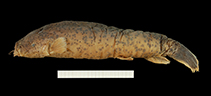
Épines dorsales (Total) : 0; Rayons mous dorsaux (Total) : 0; Épines anales: 0; Rayons mous anaux: 8 - 10; Vertèbres: 38 - 39. Diagnosis: tooth patches broad; 8-10 anal-fin rays; 20 caudal-fin rays (nearly always ii-7-8-iii); 38-39 vertebrae; body and head only slightly depressed; snout and head relatively blunt (in dorsal and lateral profile); eyes more or less lateral; body colored in shades of grey; lower lip and underside of head not especially darkened or stippled; dorsum and flank finely spotted; paired fins frequently spotted in adults; caudal fin darkly pigmented with a pale distal margin, but no pale basal crescent (young up to 70mm SL have a pale spot at the base of the caudal fin but no well-developed crescent or bar) (Ref. 44050).
Cross section: circular.
Cycle de vie et comportement reproducteur
Maturité | Reproduction | Frai | Œufs | Fécondité | Larves
Norris, S.M., 2002. A revision of the African electric catfishes, family Malapteruridae (Teleostei, Siluriformes), with erection of a new genus and descriptions of fourteen new species, and an annotated bibliography. Ann. Mus. R. Afr. Centr., Sci. Zool., 289:1-155. (Ref. 44050)
Statut dans la liste rouge de l'IUCN (Ref. 130435: Version 2025-2 (Global))
Menace pour l'homme
Harmless
Utilisations par l'homme
Outils
Articles particuliers
Télécharger en XML
Sources Internet
Estimations basées sur des modèles
Indice de diversité phylogénétique (Réf.
82804): PD
50 = 0.5000 [Uniqueness, from 0.5 = low to 2.0 = high].
Bayesian length-weight: a=0.00389 (0.00180 - 0.00842), b=3.12 (2.94 - 3.30), in cm total length, based on all LWR estimates for this body shape (Ref.
93245).
Niveau trophique (Réf.
69278): 3.4 ±0.5 se; based on size and trophs of closest relatives
Vulnérabilité de la pêche (Ref.
59153): Low vulnerability (16 of 100).
🛈