Klassifizierung / Names
Namen | Synonyme | Catalog of Fishes(Gattung, Arten) | ITIS | CoL | WoRMS | Cloffa
>
Siluriformes (Catfishes) >
Callichthyidae (Callichthyid armored catfishes) > Corydoradinae
Etymology: salmacis: Name from the Greek Salmacis, a nymph who had fallen in love with Hermaphroditus, the son of Hermes and Aphrodite, referring to the species’ very subtle sexual dimorphism when compared to other Scleromystax species; noun in apposition.
Eponymy: Salmacis is a fictional character in Ovid’s: The Fountain of Salmacis. [...] (Ref. 128868), visit book page.
More on authors: Britto & Reis.
Umwelt: Milieu / Klimazone / Tiefenbereich / Verbreitungsgebiet
Ökologie
; süßwasser demersal. Subtropical
South America: Brazil.
Größe / Gewicht / Alter
Geschlechtsreife: Lm ? range ? - ? cm
Max length : 3.7 cm SL Männchen/unbestimmt; (Ref. 56919); 5.3 cm SL (female)
Kurzbeschreibung
Bestimmungsschlüssel | Morphologie | Morphometrie
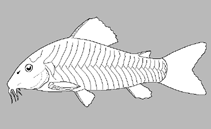
This species is distinguished by the following characters: one perforated dorsolateral body plate; ventral keel of scapulocoracoid orientated towards anterior margin of bone, its anterior portion surpassing horizontal through middle of mesial border of scapulocoracoid; preopercular-opercular region similar in males and females, with only minute, scattered odontodes; both sexes with dorsal and pectoral fins equal in length; absence of a black spot on the base of the median caudal fin rays; pectoral-fin rays I,8,i; males with somewhat more slender bodies, 25.7-30.5% in SL (range 26.3-28.8% in type series); transverse blotches along body irregular; deep caudal peduncle, 12.3-15.3% in SL (range 12.6-15.3% in type series); interorbital distance, 29.4-33.7% in HL (range 30.3-33.7% in type series); snout length, 39.9-45.5% in HL (range 39.9-43.6% in type series) (Ref. 56919).
Body shape (shape guide): elongated; Cross section: oval.
Obligate air-breathing (Ref. 126274); This species was collected from a small pond, near the arroio Molha Coco, which is surrounded Hollandichthys sp.,by grass and partially shaded by low trees and bamboo shrubs. The water is clear and slow flowing, the bottom formed by rocks covered by a thin layer of mud. This pond is fed by a very small creek and is periodically flooded by the main stream. Associated species collected at the type-locality were Steindachnerina biornata, Mimagoniates rheocharis, Astyanax scabripinnis, Rineloricaria aequalicuspis, Pareiorhaphis nudula, Phalloceros caudimaculatus and Hollandichthys sp. On the other hand, rio Ratones where the non-type specimens were caught, has a sandy bottom, with specimens collected on an open, sand bank (Ref. 56919).
Lebenszyklus und Paarungsverhalten
Geschlechtsreife | Fortpflanzung | Ablaichen | Eier | Fruchtbarkeit | Larven
Britto, M.R. and R.E. Reis, 2005. A new Scleromystax species (Siluriformes: Callichthyidae) from coastal rivers of Southern Brazil. Neotrop. Ichthyol. 3(4):481-488. (Ref. 56919)
IUCN Rote Liste Status (Ref. 130435: Version 2025-2 (Global))
Bedrohung für Menschen
Harmless
Nutzung durch Menschen
Tools
Zusatzinformationen
Download XML
Internet Quellen
Schätzungen auf der Grundlage von Modellen
Phylogenetischer Diversitätsindex (Ref.
82804): PD
50 = 0.5078 [Uniqueness, from 0.5 = low to 2.0 = high].
Bayesian length-weight: a=0.00741 (0.00287 - 0.01912), b=3.14 (2.92 - 3.36), in cm total length, based on LWR estimates for this (Sub)family-body shape (Ref.
93245).
Trophische Ebene (Ref.
69278): 3.0 ±0.3 se; based on size and trophs of closest relatives
Widerstandsfähigkeit (Ref.
120179): hoch, Verdopplung der Population dauert weniger als 15 Monate. (Preliminary K or Fecundity.).
Anfälligkeit der Fischerei (Ref.
59153): Low vulnerability (10 of 100).
🛈