>
Cyprinodontiformes (Rivulines, killifishes and live bearers) >
Anablepidae (Four-eyed fishes, onesided livebearers & white-eye) > Anablepinae
Etymology: tucumana: The name tucumana means 'from Tucumán province' in Argentina, where the type locality is situated.
Eponymy: Reverend Leonard Jenyns (1800–1893) was a clergyman and amateur naturalist. [...] (Ref. 128868), visit book page.
Milieu: milieu / Klimaatzone / Diepte / verspreidingsgebied
Ecologie
; zoet water benthopelagisch. Tropical
South America: Upper Rio Sali basin, Argentina.
Grootte / Gewicht / Leeftijd
Maturiteit: Lm ? range ? - ? cm
Max length : 4.0 cm SL mannelijk / geslacht onbekend; (Ref. 56908)
Korte beschrijving
Determinatiesleutels | Morfologie | Morfometrie
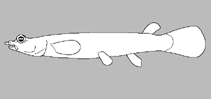
Dorsale zachte stralen (totaal) : 7 - 8; Anale zachte stralen: 10; Wervels: 31 - 32. This species differs from all its congeners by having a row of dark markings ranging from dots to small vertical stripes, on the lateral surface, from the tip of the adpressed pectoral fin to the margin of hypural. It can be further diagnosed by the combination of the following characters: two, occasionally three, rows of dorsoventrally elongate markings on the lateral surface of body; a mandibular canal pore W, a wide prootic bridge, and a symmetric fifth anal-fin ray of the tubular gonopodium; 15-16 predorsal scales; absence of a swelling between the urogenital opening and the anterior base of the anal fin in females; absence of a rounded spot on dorsal pectoral-fin base; absence of a large dorsal convex expansion at subdistal segments of right half of sixth anal-fin ray of adult males; and absence of a long posterodorsal process of the lachrymal and a shorter fourth anal-fin ray in the gonopodium (Ref. 56908).
Body shape (shape guide): fusiform / normal.
Occurs mainly in moderate to slow flowing streams with rocky bottom and algae on the substrate, where it is sympatric with Jenynsia multidentata (Ref. 56908).
Levenscyclus en paargedrag
Maturiteit | Voortplanting | Paaien | Eieren | Fecunditeit | Larven
Aguilera, G. and J.M. Mirande, 2005. A new species of Jenynsia (Cyprinodontiformes: Anablepidae) from northwestern Argentina and its phylogenetic relationships. Zootaxa 1096:29-39. (Ref. 56908)
Status op de Rode Lijst van het IUCN (Ref. 130435: Version 2025-2 (Global))
Bedreigd (EN) (B1ab(iii)+2ab(iii)); Date assessed: 15 January 2021
Gevaar voor de mens
Harmless
Gebruik door de mens
Tools
Speciale rapporten
Download XML
Internetbronnen
Schattingen op basis van modellen
Fylogenetische diversiteitsindex (Ref.
82804): PD
50 = 0.5000 [Uniqueness, from 0.5 = low to 2.0 = high].
Bayesian length-weight: a=0.01175 (0.00496 - 0.02782), b=3.08 (2.88 - 3.28), in cm total length, based on LWR estimates for this (Sub)family-body shape (Ref.
93245).
Trofisch niveau (Ref.
69278): 2.9 ±0.4 se; based on size and trophs of closest relatives
Weerstandsvermogen (Ref.
120179): Hoog, minimale populatieverdubbelingstijd minder dan 15 maanden (Preliminary K or Fecundity.).
Kwetsbaarheid van de visserij (Ref.
59153): Low vulnerability (10 of 100).
🛈