Classification / Noms
Noms communs | Synonymes | Catalog of Fishes(Genre, Espèce) | ITIS | CoL | WoRMS | Cloffa
Environnement : milieu / zone climatique / profondeur / gamme de distribution
Écologie
; eau douce démersal. Tropical
South America: Brazil.
Taille / Poids / Âge
Maturité: Lm ? range ? - ? cm
Max length : 38.0 cm TL mâle / non sexé; (Ref. 111518); poids max. publié: 67.08 g (Ref. 111518)
Description synthétique
Clés d'identification | Morphologie | Morphométrie
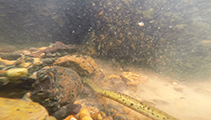
Distinguished from other species of the genus by its color pattern consisting of large roundish black blotches scattered over a light brown or yellowish ground pigmentation and presence of inconspicuous brown small spots distributed among the large dark spots. Differs further from Synbranchus marmoratus by a higher number of vertebrae and from S. madeira by a shorter post-anal length (Ref. 56782).
Body shape (shape guide): eel-like.
Facultative air-breathing (Ref. 126274); The male guards and builds nest or burrow (Ref. 205).
Cycle de vie et comportement reproducteur
Maturité | Reproduction | Frai | Œufs | Fécondité | Larves
The male guards and builds nest or burrow (Ref. 205).
Favorito, S.E., A.M. Zanata and M.I. Assumpção, 2005. A new Synbranchus (Teleostei: Synbranchiformes: Synbranchidae) from ilha de Marajó, Pará, Brazil, with notes on its reproductive biology and larval development. Neotrop. Ichthyol. 3(3):319-328. (Ref. 56782)
Statut dans la liste rouge de l'IUCN (Ref. 130435: Version 2025-2 (Global))
Menace pour l'homme
Harmless
Utilisations par l'homme
Outils
Articles particuliers
Télécharger en XML
Sources Internet
Estimations basées sur des modèles
Indice de diversité phylogénétique (Réf.
82804): PD
50 = 0.6250 [Uniqueness, from 0.5 = low to 2.0 = high].
Bayesian length-weight: a=0.00076 (0.00043 - 0.00135), b=3.10 (2.94 - 3.26), in cm total length, based on LWR estimates for this species & (Sub)family-body (Ref.
93245).
Niveau trophique (Réf.
69278): 3.2 ±0.3 se; based on size and trophs of closest relatives
Résilience (Réf.
120179): Milieu, temps minimum de doublement de population : 1,4 à 4,4 années (Preliminary K or Fecundity.).
Vulnérabilité de la pêche (Ref.
59153): Low to moderate vulnerability (28 of 100).
🛈