This website uses cookies to enhance your browsing experience and ensure the functionality of our site. For more detailed information about the types of cookies we use and how we protect your privacy, please visit our Privacy Information page.
×
Cookie Settings
This website uses different types of cookies to enhance your experience. Please select your preferences below:
分类 / 名称 俗名 | 同种异名 | Catalog of Fishes(属, 种) | ITIS | CoL | WoRMS | Cloffa
Teleostei > Beloniformes (Needle fishes) > Adrianichthyidae (Ricefishes) > Oryziinae
Etymology: Oryzias:Greek, oryza = rice; because of the habitat used by this fish (Ref. 45335).
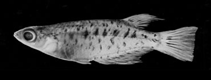
背的软条 (总数) : 9 - 10; 臀鳍软条: 22 - 25. This species is distinguished (from O. profundicola, O. loxolepis) by the following characters: abdominal vertebrae usually 12, total vertebrae 29-31; D 9-10, A 22-25; transverse scales 10-11; body depth at anal-fin origin 24.8-30.1% SL and at dorsal-fin origin 20.2-25.3% SL; caudal peduncle length 12.0-16.3% SL; distinct nuchal concavity; lateral scales are more-or-less aligned parallel to midlateral stripe; male with elongated-shaped dorsal fin without yellow margin (Ref. 133090). Cross section: compressed. 与本属的所有其他成员区分了藉由下列特征的组合: 20-26个臀鳍鳍条; 9-12个背鳍鳍条; 在侧面的列中 31-32个鳞片; 体高 25-31% SL; 而且雄鱼的彩色斑纹活着时,以灰褐色的头部与身体有,扩散的深褐色的斑块不规则地在身体上散布了而且总是有一列 5-9个较大的斑块约略不规则地组织在轴的斑纹上面.(参考文献 26687)
Non-annual breeder. Is very difficult to maintain in aquarium (Ref. 27139). In 2013 and 2018, the collected and observed specimens were only during the day and at TanjungTimbala, slightly south of the type locality, and at Lengkona in Lake Towuti. This species is collected with O. loxolepis and O. profundicola that form schools in gently sloping, shallow (< 1.5 m) shore areas with large boulders and submerged wood over sand and gravel. Other taxa occurring in samples included Paratherina spp., Glossogobius flavipinnis, G. intermedius, Glossogobius sp., Mugilogobius rexi, M. latifrons, and Nomorhamphus megarrhamphus. In Lake Lantoa, it inhabits gently sloping, shallow shores (1 m depth) with a large area of plants on a muddy substratum. It swims in schools and was collected in association with Telmatherina celebensis and Glossogobius sp. (an undescribed lake endemic: HK, pers. obsv.). Some individuals were infested with parasitic copepods. In Lake Mahalona, it also inhabits gently sloping, shallow shores (1 m depth) with large boulders over a sand and gravel substratum, covered with aquatic vegetation. Often, it also forms schools and co-occurring with Tominanga aurea, Glossogobius sp. (as for Lake Towuti), Glossogobius mahalonensis, G. intermedius, M. rexi, and Mugilogobius cf. hitam (Ref. 133093).
Kottelat, M., A.J. Whitten, S.N. Kartikasari and S. Wirjoatmodjo, 1993. Freshwater fishes of Western Indonesia and Sulawesi. Periplus Editions, Hong Kong. 221 p. (Ref. 7050)
世界自然保护联盟红皮书 (Ref. 130435: Version 2025-2 (Global))
临近濒危 (NT) (B1b(i,ii,iii,iv)+2b(i,ii,iii,iv)); Date assessed: 13 June 2018
系统发育多样性指数 (参考文献 82804): PD50 = 0.5000 [Uniqueness, from 0.5 = low to 2.0 = high].
Bayesian length-weight: a=0.00479 (0.00190 - 0.01207), b=3.13 (2.91 - 3.35), in cm total length, based on LWR estimates for this (Sub)family-body shape (Ref. 93245).
营养阶层 (参考文献 69278): 3.4 ±0.4 se; based on size and trophs of closest relatives