>
Gobiesociformes (Clingfishes) >
Gobiesocidae (Clingfishes and singleslits) > Cheilobranchinae
Etymology: Alabes: Greek, alabes, oy = a fish from the Nile, dealing with lampreys (Ref. 45335); gibbosa: Named for the hunch-backed appearance of the species (B. Hutchins, pers. comm. 05/05/06).
Environnement : milieu / zone climatique / profondeur / gamme de distribution
Écologie
marin démersal; profondeur 2 - 4 m (Ref. 56640). Subtropical
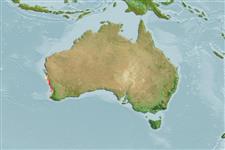
Eastern Indian Ocean: Western Australia.
Taille / Poids / Âge
Maturité: Lm ? range ? - ? cm
Max length : 9.1 cm SL mâle / non sexé; (Ref. 56640)
Description synthétique
Clés d'identification | Morphologie | Morphométrie
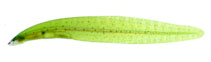
Diagnosis: Pelvic fins rudimentary. Gill slit medium. Postocular pore 2, wide; anterior nasal and lacrymal pores present; posterior nasal pore absent. Vertebrae total 60-61, precaudal 22; last epineural on the 20th vertebra. Caudal rays 9-11. Dorsal origin over the anus. Body not transparent. This species differs from it congeners by a combination of its deep body (depth 7.8-9.5 in SL), which usually exhibits a gibbous dorsal profile, relatively large gill slit (3.3-3.9 in HL), large gill slit (2.9-4.4 in HL), prominent rudimentary pelvic fin with obvious fin rays, two postocular pore on each side of head, and unique color pattern. It is most similar to A. brevis, differing in its deeper and larger body, presence of a post nasal pore (usually absent in the latter species), more vertebrae (68-69 versus 61-62), and different coloration, where males of this species never develop a tigerlike pattern of irregular dark bars on the side of the head as found in A. brevis (Ref. 56640).
Body shape (shape guide): eel-like.
Collected from shallow coastal waters, in seagrass areas (Ref. 56640).
Cycle de vie et comportement reproducteur
Maturité | Reproduction | Frai | Œufs | Fécondité | Larves
Hutchins, J.B. and S. Morrison, 2004. Five new species of the genus Alabes (Gobiesocidae: Cheilobranchinae). Rec. Australian Mus. 56:147-158. (Ref. 56640)
Statut dans la liste rouge de l'IUCN (Ref. 130435: Version 2025-2 (Global))
Menace pour l'homme
Harmless
Utilisations par l'homme
Outils
Articles particuliers
Télécharger en XML
Sources Internet
Estimations basées sur des modèles
Température préférée (Réf.
123201): 16.9 - 22.7, mean 18.3 °C (based on 89 cells).
Indice de diversité phylogénétique (Réf.
82804): PD
50 = 0.5005 [Uniqueness, from 0.5 = low to 2.0 = high].
Bayesian length-weight: a=0.00102 (0.00046 - 0.00225), b=3.06 (2.88 - 3.24), in cm total length, based on all LWR estimates for this body shape (Ref.
93245).
Niveau trophique (Réf.
69278): 3.4 ±0.3 se; based on size and trophs of closest relatives
Résilience (Réf.
120179): Milieu, temps minimum de doublement de population : 1,4 à 4,4 années (Preliminary K or Fecundity.).
Vulnérabilité de la pêche (Ref.
59153): Low vulnerability (10 of 100).
🛈