Classification / Noms
Noms communs | Synonymes | Catalog of Fishes(Genre, Espèce) | ITIS | CoL | WoRMS | Cloffa
>
Blenniiformes (Blennies) >
Blenniidae (Combtooth blennies) > Blenniinae
Etymology: Salariopsis: The suffix -opsis, from the ancient Greek 'view, appearance', is added to the epithet "Salaria" to highlight its apparent, but misleading, morphological similarity to the blenniid genus Salaria Forsskål, 1775 (Ref. 128181).
Eponymy: Professor Dr Panos Stavros Economidis was formerly Director of the Ichthyology and Zoology Laboratories in the School of Biology, Aristotle University of Thessaloniki and was the main contributor to its fish collection. [...] (Ref. 128868), visit book page.
More on author: Kottelat.
Environnement : milieu / zone climatique / profondeur / gamme de distribution
Écologie
; eau douce démersal; profondeur 0 - 2 m (Ref. 59043). Temperate
Taille / Poids / Âge
Maturité: Lm ? range ? - ? cm
Max length : 7.3 cm TL mâle / non sexé; (Ref. 125981); poids max. publié: 4.80 g (Ref. 125981)
Description synthétique
Clés d'identification | Morphologie | Morphométrie
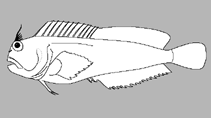
Épines dorsales (Total) : 12 - 13; Rayons mous dorsaux (Total) : 16 - 17; Épines anales: 2; Rayons mous anaux: 16 - 19; Vertèbres: 36. Diagnosis: This species is distinguished from its congeners in European inland waters by the following combination of characters: cheeks with 3-5 rows of bold black dots, roughly running diagonally from eye backward and downward, with space between 2 of the lower rows greyish and spaces between upper rows paler; simple cirrus above eye; head length 29-33% SL; upper jaw with 25-30 teeth, lower jaw with 20-27; A II,16-19; D XII-XIII,16-17 (Ref. 59043).
Body shape (shape guide): fusiform / normal.
Facultative air-breathing in the genus (Ref. 126274); A territorial species found in lake shores and usually in dense vegetation at 0.3 to 2 m depth. Adults feed on insects and crustaceans. They spawn in May-July. Eggs hatch in about one week. Larvae are planktonic until about 15 mm. (Ref. 59043).
Cycle de vie et comportement reproducteur
Maturité | Reproduction | Frai | Œufs | Fécondité | Larves
Oviparous, distinct pairing (Ref. 205).
Vecchioni, L., A.C. Ching, F. Marrone, M. Arculeo, P.J. Hundt and A.M. Simons, 2022. Multi-locus phylogenetic analyses of the Almadablennius clade reveals inconsistencies with the present taxonomy of blenniid fishes. Diversity 14(1,53):1-9. (Ref. 128181)
Statut dans la liste rouge de l'IUCN (Ref. 130435: Version 2025-2 (Global))
Menacé (EN) (B1ab(iii)+2ab(iii)); Date assessed: 15 August 2023
Menace pour l'homme
Harmless
Utilisations par l'homme
Outils
Articles particuliers
Télécharger en XML
Sources Internet
Estimations basées sur des modèles
Indice de diversité phylogénétique (Réf.
82804): PD
50 = 0.6250 [Uniqueness, from 0.5 = low to 2.0 = high].
Bayesian length-weight: a=0.01047 (0.00525 - 0.02089), b=3.10 (2.92 - 3.28), in cm total length, based on LWR estimates for this species & (Sub)family-body (Ref.
93245).
Niveau trophique (Réf.
69278): 3.3 ±0.4 se; based on size and trophs of closest relatives
Résilience (Réf.
120179): Haut, temps minimum de doublement de population inférieur à 15 mois (Preliminary K or Fecundity.).
Vulnérabilité de la pêche (Ref.
59153): Low vulnerability (10 of 100).
🛈