Klassifizierung / Names
Namen | Synonyme | Catalog of Fishes(Gattung, Arten) | ITIS | CoL | WoRMS | Cloffa
>
Characiformes (Characins) >
Iguanodectidae ("Lizard bite tetras")
Etymology: Bryconops: Greek, bryko = to bite + Greek, ops = appearance (Ref. 45335); collettei: Named for Bruce B. Collette.
Eponymy: Dr Bruce Baden Collette (d: 1934) is an American ichthyologist. [...] (Ref. 128868), visit book page.
Umwelt: Milieu / Klimazone / Tiefenbereich / Verbreitungsgebiet
Ökologie
; süßwasser benthopelagisch. Tropical
South America: Venezuela.
Größe / Gewicht / Alter
Geschlechtsreife: Lm ? range ? - ? cm
Max length : 7.8 cm SL Männchen/unbestimmt; (Ref. 56366)
Kurzbeschreibung
Bestimmungsschlüssel | Morphologie | Morphometrie
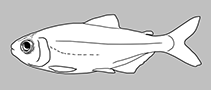
Rückenflossenweichstrahlen (insgesamt) : 11; Afterflossenweichstrahlen: 29 - 36; Wirbelzahl: 40 - 44. Diagnosis: Differs from its congeners except B. magoi by its unique color pattern, red coloration at the upper half of a diffuse caudal fin ocellus. Further distinguished from other species of the subgenus Bryconops by the following characters: pored lateral scales 44-48, modally 47 (vs. >57 in alburnoides, <31 in disruptus and durbini, and 43-47, modally 44 or 45 in magoi); pored lateral scales extending 2-3 scales beyond end of hypural plate onto caudal fin rays (vs. caudomaculatus, it reaches end of hypural plate and not onto caudal fin rays); snout length 4.2-5.4%, mean 4.7% (vs. 5.8-8% SL, mean 6.8% in magoi); length of anal fin base 27.3-29.8% SL, mean 28.8% (vs. 24.8-27.9%, mean 26.6% in magoi); and total vertebrae 42-44, modally 43 (vs. 40-42, modally 41-42 in magoi) (Ref. 56366).
Found in habitats with moderate to fast moving waters over rocky and sandy bottoms; in both acidic, black waters, as well as in clear, but slightly acidic waters. In the Caura, it was found in rapids covered by vascular plants (Podostemonacae), as well as in small springs with sandy bottoms. Found in the upper part of the water column in the main channel, usually in schools with other characid species. Observed food items include several groups of terrestrial insects (Ref. 56366).
Lebenszyklus und Paarungsverhalten
Geschlechtsreife | Fortpflanzung | Ablaichen | Eier | Fruchtbarkeit | Larven
Chernoff, B. and A. Machado-Allison, 2005. Bryconops magoi and Bryconops collettei (Characiformes: Characidae), two new freshwater fish species from Venezuela, with comments on B. caudomaculatus (Günther). Zootaxa 1094:1-23. (Ref. 56366)
IUCN Rote Liste Status (Ref. 130435: Version 2025-2 (Global))
Bedrohung für Menschen
Harmless
Nutzung durch Menschen
Tools
Zusatzinformationen
Download XML
Internet Quellen
Schätzungen auf der Grundlage von Modellen
Phylogenetischer Diversitätsindex (Ref.
82804): PD
50 = 0.5000 [Uniqueness, from 0.5 = low to 2.0 = high].
Bayesian length-weight: a=0.00589 (0.00252 - 0.01376), b=3.18 (2.97 - 3.39), in cm total length, based on LWR estimates for this (Sub)family-body shape (Ref.
93245).
Trophische Ebene (Ref.
69278): 3.2 ±0.4 se; based on size and trophs of closest relatives
Anfälligkeit der Fischerei (Ref.
59153): Low vulnerability (10 of 100).
🛈