Klassifizierung / Names
Namen | Synonyme | Catalog of Fishes(Gattung, Arten) | ITIS | CoL | WoRMS | Cloffa
>
Siluriformes (Catfishes) >
Auchenipteridae (Driftwood catfishes) > Centromochlinae
Etymology: Tatia: Because of Mr. C. Tate Regan (Ref. 45335); bockmanni: Named for Flávio Alicino Bockmann, Universidade de São Paulo, who collected the specimens that led us to the recognition of the species as an undescribed species (Ref. 56311).
Eponymy: Dr Flávio Alicino Bockman works at the Laboratório de Ictiologia de Ribeirão Preto, Departamento de Biologia, Faculdade de Filosofia, Ciências e Letras, Universidade de São Paulo, Brazil. [...] (Ref. 128868), visit book page.
Umwelt: Milieu / Klimazone / Tiefenbereich / Verbreitungsgebiet
Ökologie
; süßwasser demersal; tiefenbereich 0 - 2 m (Ref. 56311). Tropical
South America: Brazil.
Größe / Gewicht / Alter
Geschlechtsreife: Lm ? range ? - ? cm
Max length : 4.8 cm SL Männchen/unbestimmt; (Ref. 56311)
Kurzbeschreibung
Bestimmungsschlüssel | Morphologie | Morphometrie
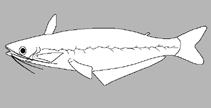
Rückenflossenstacheln (insgesamt) : 1; Rückenflossenweichstrahlen (insgesamt) : 5. Diagnosis: This species is distinguished from its congeners by the autapomorphic reduced ossified suprapreopercular canal. In auchenipterids the suprapreopercle is a short canal bone lying above the preopercle and containing the dorsal end of the opercular lateral line canal, which passes through it and enters the pterotic; and among centromochlines, this canal bone may vary. In some forms (as in Centromochlus perugiae, C. heckelii, and C. existimatus, a suprapreopercular ossification is absent, but in most forms it is present as a tube, completing the space between preopercle and the pterotic. In G. bockmanni, the suprapreopercle is not represented as a tube. This small canal bone is an incompletely ossified tube between the preopercle and the pterotic, with the bony portion located close to the preopercle. A fully ossified suprapreopercle was not detected in G. bockmanni. Glanidium bockmanni further differs from its congeners (albescens, ribeiroi, catharinensis, melanopterum, and leapardus in having a small adult size 29-48 mm SL (vs. 70-195 mm SL); lower jaw of equal size (vs. slightly prognathous); first nuchal plate absent (vs. present); low number of vertebrae 32 (vs. 3440); anal fin with 7 branched rays (vs. 8-11); and a less voluminous muscle adductor mandibulae A2 associated with a discrete concavity between sphenotic and pterotic (vs. thickened A2 associated with a quite pronounced concavity). It very closely resembles G. cesarpintoi , but can be distinguished from it due to larger post-cleithral process (20% SL vs. 16% SL); shorter mesethmoid (15% HL vs. 25% HL); adipose fin present (vs. absent); and pectoral-fin spine with antrorse spinules on anterior margin (vs. retrorse in cesarpintoi) (Ref. 56311).
Body shape (shape guide): elongated; Cross section: compressed.
The single specimen was captured in an area with gravel and rocky bottom, near the margin of the river (F. Bockmann, pers. comm.). The fishes from Bahia were captured by seine at night in a riverine beach in clear, shallow water with sand and gravel bottom in depth less than 1.70 m. Stomach contents of two specimens were partially digested fragments of insect larvae and nymphs (Ref. 56311).
Lebenszyklus und Paarungsverhalten
Geschlechtsreife | Fortpflanzung | Ablaichen | Eier | Fruchtbarkeit | Larven
Sarmento-Soares, L.M. and P.A. Buckup, 2005. A new Glanidium from the Rio São Francisco Basin, Brazil (Siluriformes: Auchenipteridae: Centromochlinae). Copeia 2005(4):846-853. (Ref. 56311)
IUCN Rote Liste Status (Ref. 130435: Version 2025-2 (Global))
Bedrohung für Menschen
Harmless
Nutzung durch Menschen
Fischereien: nicht kommerziell
Tools
Zusatzinformationen
Download XML
Internet Quellen
Schätzungen auf der Grundlage von Modellen
Phylogenetischer Diversitätsindex (Ref.
82804): PD
50 = 0.5000 [Uniqueness, from 0.5 = low to 2.0 = high].
Bayesian length-weight: a=0.00490 (0.00199 - 0.01208), b=3.10 (2.88 - 3.32), in cm total length, based on LWR estimates for this (Sub)family-body shape (Ref.
93245).
Trophische Ebene (Ref.
69278): 3.2 ±0.4 se; based on size and trophs of closest relatives
Anfälligkeit der Fischerei (Ref.
59153): Low vulnerability (10 of 100).
🛈