>
Siluriformes (Catfishes) >
Ictaluridae (North American freshwater catfishes)
Etymology: Noturus: Greek, noton = back + Greek, oura = tail; refred to the position of the tail over the back (Ref. 45335); fasciatus: Specific name from a Latin work meaning envelop with bands, referring to the striking bands or saddles on th eupper half of the body.
Entorno: milieu / zona climática / rango de profundidad / gama de distribución
Ecología
; agua dulce bentopelágico. Subtropical
North America: USA.
Longitud en la primera madurez / Tamaño / Peso / Edad
Madurez: Lm ?, range 4 - ? cm
Max length : 8.5 cm TL macho / no sexado; (Ref. 86798)
Descripción breve
Claves de identificación | Morfología | Morfometría
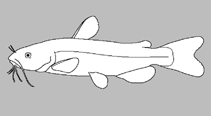
Radios blandos dorsales (total) : 5 - 6; Radios blandos anales: 16 - 20. Diagnosis: Differs from other Noturus elegans species group by the following: anal fin more elongate with modally 18 rays (vs. 16); Nape with boldly contrasting pigment pattern of 3-4 ivory to yellow ellipses; dorsum interrupted by dark chocolate brown saddles (vs. pale blotches not strongly contrasting); adipose fin blotch extending to middle of fin, but nearly always to its edge (vs. blotch in lower half of fin or confined to base); small, dark saddle on ventral edge of caudal peduncle (vs. dark saddle absent from caudal peduncle); adipose fin rather high, intermediate in length and weakly connected to caudal fin (vs. low, long in length, and moderately connected to caudal fin in N. crypticus or moderate in height and length and well connected to caudal fin in N. elegans); diffuse band or crescent-shaped dark blotch at caudal fin base (vs. dark crescent-shaped blotch absent at caudal fin base); modally 36 post Weberian vertebrae (vs. modally 34-35); slender body shape, with body width at pectoral fin origin 21 % or less of SL and shorter than anal fin base length (vs. body width 23% or more of SL and longer than anal fin base length in N. crypticus). Noturus elegans and N. fasciatus differ by 6.6% sequence divergence (uncorrected p) for Cytb and unique genotype distributions for eight allozyme loci: s-AAT-A, FUM-A, GPI-A, sICDH-A, LDH-B, MPI-A, Pep-B, and PGM-A (Ref. 56218).
Collected from riffle habitats with gravel, cobble, rubble, or slate substrate; mean depth of 0.2 meters (0.1 - 0.3 m), and stream width averaged 13.6 meters (range 8 - 25 m); mean current readings from the 3 capture sites ranged from 0.59 - 0.76 meters per second. Riffles are typically occupied during daylight hours when individuals are likely buried within the interstices of gravel. Based on its small adult size (to 72 mm SL), this species probably lives no longer than 2-3 years. Preserved females contain mature oocytes from late May to late July; females are mature at sizes as small as 44 mm SL (Ref. 56218). Migratory behaviour is undetermined (Ref. 126106).
Ciclo vital y comportamiento de apareamiento
Madurez | Reproducción | Puesta | Huevos | Fecundidad | Larva
Burr, B.M., D.J. Eisenhour and J.M. Grady, 2005. Two new species of Noturus (Siluriformes: Ictaluridae) from the Tennessee River drainage: description, distribution, and conservation status. Copeia 2005(4):783-802. (Ref. 56218)
Situación en la Lista Roja de la UICN (Ref. 130435: Version 2025-2 (Global))
Amenaza para el ser humano
Harmless
Usos humanos
Herramientas
Informes especiales
Descargar XML
Fuentes de Internet
Estimaciones basadas en modelos
Índice de diversidad filogenética (Referencia
82804): PD
50 = 0.5000 [Uniqueness, from 0.5 = low to 2.0 = high].
Bayesian length-weight: a=0.00589 (0.00256 - 0.01357), b=3.07 (2.87 - 3.27), in cm total length, based on LWR estimates for this (Sub)family-body shape (Ref.
93245).
Nivel trófico (Referencia
69278): 3.3 ±0.4 se; based on size and trophs of closest relatives
Resiliencia (Referencia
120179): Alto, población duplicada en un tiempo mínimo inferior a 15 meses (Preliminary K or Fecundity.).
Vulnerabilidad pesquera (Ref.
59153): Low vulnerability (10 of 100).
🛈