Classificação / Nomes
Nomes comuns | Sinônimos | Catalog of Fishes(Gênero, Espécies) | ITIS | CoL | WoRMS | Cloffa
>
Synbranchiformes (Spiny eels) >
Mastacembelidae (Spiny eels)
Etymology: Mastacembelus: Greek, mastax, -agos = bite + Greek, emballo = to throw oneself (Ref. 45335); polli: Named in honor of Prof. Dr. Poll, a famous Belgian ichthyologist who pioneered ichthyological studies on Lake Tanganyika (Ref. 56055).
Eponymy: Dr Max Fernand Leon Poll (1908–1991) was a Belgian ichthyologist, and ‘connoisseur of the fish fauna’. [...] (Ref. 128868), visit book page.
Meio ambiente: milieu / Zona climática / intervalo de profundidade / faixa de distribuição
Ecologia
; Água doce demersal. Tropical
Africa: endemic to and widely distributed in Lake Tanganyika (Ref. 56055).
Tamanho / Peso / Idade
Maturidade: Lm ? range ? - ? cm
Max length : 14.0 cm SL macho/indeterminado; (Ref. 56055)
Descrição suscinta
Chaves de identificação | Morfologia | Morfometria
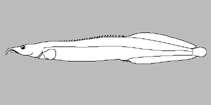
Espinhos dorsais (total) : 22 - 29; Raios dorsais (total) : 68 - 87; Espinhos anais: 2; Raios anais : 70 - 98; Vértebras: 72 - 84. The species has protruding eyes, a small rostral appendage, a protruding lower jaw, a pointed caudal fin and a more elongated pectoral-fin shape (Ref. 56055). Posterior angle of lips is situated below the region from the middle from the eye up to a distance of about one-third of the diameter behind posterior border of eye (Ref. 56055). Upper corner of gill opening and dorsal edge of pectoral-fin base approximately at same level, clearly anterior to ventral edge of pectoral-fin base; dorsal edge of pectoral-fin base situated above upper corner of the gill opening (Ref. 56055). Lateral line continuous from posterior border of head up to one-third or half of distance between head and anus, discontinuous more posteriorly (Ref. 56055). Preanal length always shorter than postanal length; distance from anterior border of snout to last externally visible dorsal spine always longer than distance from anterior border of snout to last externally visible anal spine, and as a result origin of soft dorsal fin always posterior compared to origin of soft anal fin (Ref. 56055). Dorsal spines increasing in size from first to last (Ref. 56055). One well-developed, externally visible anal spine; a very small almost entirely reduced spine, hidden under the skin, can be present (Ref. 56055). Preopercular and preorbital spines are absent (Ref. 56055).
It has a uniformly light brown overall background colour with numerous small, round, dark brown spots on the dorsal part of head, body and tail (Ref. 56055). Background colour lighter, more yellowish white on lips, ventral region of head, belly and most ventral part of tail (Ref. 56055). Pectoral fins whitish transparent without spots; dorsal, caudal and anal fins also whitish transparent (Ref. 56055).
Body shape (shape guide): eel-like.
Coastal in distribution; habitat is rocky bottom, flagstone, rock slides and pebbles (Ref. 56055).
Ciclo de vida ou comportamento de acasalamento
Maturidade | Reprodução | Desova | Ovos | Fecundidade | Larvas
Vreven, E.J., 2005. Redescription of Mastacembelus ophidium Günther, 1893 (Synbranchiformes: Mastacembelidae) and description of a new spiny eel from Lake Tanganyika. J. Nat. Hist. 39(18):1539-1560. (Ref. 56055)
Status na Lista Vermelha da UICN (Ref. 130435: Version 2025-2 (Global))
Ameaça para os humanos
Harmless
Uso pelos humanos
Ferramentas
Relatórios especiais
Baixar XML
Fontes da internet
Estimativas baseadas em modelos
Índice de diversidade filogenética (Ref.
82804): PD
50 = 0.5000 [Uniqueness, from 0.5 = low to 2.0 = high].
Bayesian length-weight: a=0.00269 (0.00129 - 0.00562), b=2.94 (2.76 - 3.12), in cm total length, based on LWR estimates for this (Sub)family-body shape (Ref.
93245).
Nível Trófico (Ref.
69278): 3.6 ±0.6 se; based on size and trophs of closest relatives
Resiliência (Ref.
120179): Elevada, tempo mínimo de duplicação da população menor que 15 meses (Preliminary K or Fecundity.).
Vulnerabilidade da pesca (Ref.
59153): Low vulnerability (10 of 100).
🛈