>
Centrarchiformes (Basses) >
Terapontidae (Grunters or tigerperches)
Etymology: Hephaestus: Taken from Haphaistos, the God of fire in the Greek mythology; 1658 (Ref. 45335).
Eponymy: In Greek mythology, Hephaestus was the god of fire, blacksmiths, metal-workers and other artisans. De Vis gives no reason for his choice of name. The Corydoras was so named due to the red (fiery) colour of its fins and parts of its body. (Ref. 128868), visit book page.
Milieu: milieu / Klimaatzone / Diepte / verspreidingsgebied
Ecologie
; zoet water benthopelagisch. Tropical
Oceania: northeastern Queensland, Australia.
Grootte / Gewicht / Leeftijd
Maturiteit: Lm ? range ? - ? cm
Max length : 30.0 cm SL mannelijk / geslacht onbekend; (Ref. 44894)
Korte beschrijving
Determinatiesleutels | Morfologie | Morfometrie
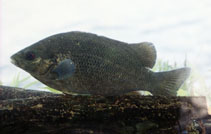
Dorsale stekels (totaal) : 7; Dorsale zachte stralen (totaal) : 11 - 12; Anale stekels: 3; Anale zachte stralen: 7 - 10. Greatest body depth 2.2-2.5 in SL. Compared to H. fuliginosus, this species lacks the dark band across the pectoral fin base and the concave forehead-snout profile; and its relatively long pelvic fins reach the vicinity of the anus when depressed against the body (Ref. 44894).
Adults are found abundantly in faster flowing sections of rivers, including riffles, over gravel, cobble and rocky bottoms. Sexual maturity is reached at about 13 m for males. Spawning occurs from July to October. Feed on a variety of macroinvertebrates, including crustaceans, aquatic and terrestrial insects, and algae (Ref. 44894). Eggs are guarded and fanned by the male parent (Ref. 205).
Levenscyclus en paargedrag
Maturiteit | Voortplanting | Paaien | Eieren | Fecunditeit | Larven
Eggs are guarded and fanned by the male parent (Ref. 205).
Allen, G.R., S.H. Midgley and M. Allen, 2002. Field guide to the freshwater fishes of Australia. Western Australian Museum, Perth, Western Australia. 394 p. (Ref. 44894)
Status op de Rode Lijst van het IUCN (Ref. 130435: Version 2025-2 (Global))
Gevaar voor de mens
Harmless
Gebruik door de mens
Tools
Speciale rapporten
Download XML
Internetbronnen
Schattingen op basis van modellen
Fylogenetische diversiteitsindex (Ref.
82804): PD
50 = 0.5001 [Uniqueness, from 0.5 = low to 2.0 = high].
Bayesian length-weight: a=0.01660 (0.00632 - 0.04360), b=2.99 (2.76 - 3.22), in cm total length, based on LWR estimates for this (Sub)family-body shape (Ref.
93245).
Trofisch niveau (Ref.
69278): 3.3 ±0.5 se; based on size and trophs of closest relatives
Weerstandsvermogen (Ref.
120179): Gemiddeld, minimale populatieverdubbelingstijd 1,4-4,4 jaar (Preliminary K or Fecundity.).
Kwetsbaarheid van de visserij (Ref.
59153): Low to moderate vulnerability (27 of 100).
🛈