>
Clupeiformes (Herrings) >
Engraulidae (Anchovies) > Coiliinae
Etymology: Coilia: Greek, koilia, -as = abdomen, hollow (Ref. 45335).
Eponymy: Jean-Jacques Dussumier (1792–1883) was a French merchant, collector, traveller and ship owner. [...] (Ref. 128868), visit book page.
More on author: Valenciennes.
Ambiente: milieu / zona climática / intervalo de profundidade / gama de distribuição
Ecologia
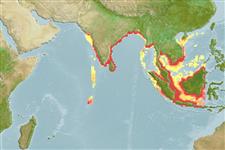
marinhas; Água doce; estuarina pelagic-neritic; anfídromo (Ref. 51243); intervalo de profundidade 0 - 50 m (Ref. 189). Tropical; 24°N - 9°S, 70°E - 118°E (Ref. 189)
Indian Ocean: India from Bombay to Calcutta, probably also Myanmar, Thailand and Malaysia. Western Central Pacific: Thailand to Java, presumably also Kalimantan). Valenciennes listed a specimen from Mahé which lies to the south of Cannanore, India but there is no such specimen in Paris.
Comprimento na primeira maturidade / Tamanho / Peso / Idade
Maturidade: Lm ?, range 1 - ? cm
Max length : 20.0 cm SL macho/indeterminado; (Ref. 9822); common length : 17.0 cm TL macho/indeterminado; (Ref. 9822)
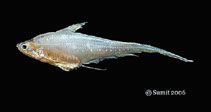
Espinhos dorsais (total) : 0; Espinhos anais: 0; Raios anais moles: 80. Body tapering, belly rounded before pelvic fins, with 5 or 6 (rarely 4) + 7 to 9 = 12 to 15 keeled scutes from just behind pectoral fin base to anus. Maxilla short. Pectoral fin with 6 long filaments and 9 to 11 (rarely 8) branched fin rays. Flanks and belly with golden or pearly spots (light organs) in rows below scales, also along isthmus, edge of lower jaw, on cheek and gill cover.
Body shape (shape guide): elongated; Cross section: compressed.
A coastal and estuarine species, occurring in fully saline water, but also able to tolerate lowered salinities, perhaps almost fresh water. Feeds on copepods, prawn and fish larvae, various unidentified crustaceans and cypris, also stomatopod larvae, mysids, polychaete larvae, isopods and Sagitta. The breeding season is perhaps extended; probably entering estuaries to breed (larvae about 5 km up Burhabalang estuary, Orissa, India in May and June). Utilized as a food fish (Ref. 171).
Breeding season is perhaps extended. Spawn in school (Ref. 205).
Wongratana, T., T.A. Munroe and M. Nizinski, 1999. Order Clupeiformes. Engraulidae. Anchovies. p. 1698-1753. In K.E. Carpenter and V.H. Niem (eds.) FAO species identification guide for fishery purposes. The living marine resources of the WCP. Vol. 3. Batoid fishes, chimaeras and bony fishes part 1 (Elopidae to Linophrynidae). FAO, Rome. (Ref. 9822)
Categoria na Lista Vermelha da IUCN (Ref. 130435: Version 2025-2 (Global))
Ameaça para o homem
Harmless
Utilização humana
Pescarias: espécies comerciais
Ferramentas
Relatórios especiais
Descarregue XML
Fontes da internet
Estimativas baseadas em modelos
Temperatura preferida (Ref.
123201): 27.6 - 29.3, mean 28.7 °C (based on 640 cells).
Índice de diversidade filogenética (Ref.
82804): PD
50 = 0.5001 [Uniqueness, from 0.5 = low to 2.0 = high].
Bayesian length-weight: a=0.00355 (0.00194 - 0.00650), b=3.01 (2.85 - 3.17), in cm total length, based on LWR estimates for this species & Genus-body shape (Ref.
93245).
Nível Trófico (Ref.
69278): 3.3 ±0.39 se; based on food items.
Generation time: 0.9 (0.8 - 1.0) years. Estimated as median ln(3)/K based on 12
growth studies.
Resiliência (Ref.
120179): Elevada, tempo mínimo de duplicação da população menor que 15 meses (tm=0.5-0.6; K=1.07-1.54; Fec=1,000-5,000).
Vulnerabilidade da pesca (Ref.
59153): Low vulnerability (14 of 100).
🛈
Nutrientes (Ref.
124155): Calcium = 398 [117, 1,022] mg/100g; Iron = 2.56 [0.78, 7.00] mg/100g; Protein = 17.3 [14.5, 20.2] %; Omega3 = 0.306 [0.155, 0.612] g/100g; Selenium = 50.5 [22.8, 113.4] μg/100g; VitaminA = 18.1 [5.4, 46.9] μg/100g; Zinc = 1.62 [0.78, 3.23] mg/100g (wet weight); based on
nutrient studies.