>
Cypriniformes (Carps) >
Gobionidae (Gudgeons)
Etymology: Gobio: Latin, gobius = gudgeon (Ref. 45335); lozanoi: Named for Luis Lozano Rey (1878-1958) for his contribution to the knowledge of Iberian freshwater fishes.
Eponymy: Dr Luis Lozano Rey (1878–1958) was a Spanish naturalist. [...] (Ref. 128868), visit book page.
Environnement : milieu / zone climatique / profondeur / gamme de distribution
Écologie
; eau douce benthopélagique; potamodrome (Ref. 138297). Temperate
Europe: Iberian Peninsula and France (Ref. 57030) in the Adour drainage. Spain: Ebro and Bidasoa drainage (Ref. 59043).
Taille / Poids / Âge
Maturité: Lm ? range ? - ? cm
Max length : 13.5 cm TL mâle / non sexé; (Ref. 71904)
Description synthétique
Clés d'identification | Morphologie | Morphométrie
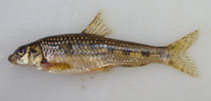
Épines dorsales (Total) : 2 - 3; Rayons mous dorsaux (Total) : 7; Épines anales: 2 - 3; Rayons mous anaux: 6. Distinguished from all other species of Gobio by the following characters: 36-39 scales in the lateral line, 3 scales below the lateral line, distance between pectoral and ventral fin is greater than ventral anal distance, preorbital distance is short and the head is wide (Ref. 57030). Other diagnostic characters that separate this species from its congeners in Europe include: scale rows between lateral line and dorsal origin usually 5½ ;scale rows around caudal peduncle 12-14; scales between anus and anal origin 4-5; breast scaled forward at most to posterior extremity of pectoral-fin base; interorbital area flat to slightly convex; head length 25-28% SL; head depth 62-72% HL; eye diameter 1.2-1.8 times in interorbital distance; caudal peduncle depth 1.6-2.0 times in its length; midlateral blotches contrasted, posterior ones with sharp margin (Ref. 59043).
Body shape (shape guide): fusiform / normal.
Adults occur in streams and rivers with clear water, gravel or sandy bottoms (Ref. 57030). Also found in slow moving lowland waters with gravel, sandy and clay bottoms (Ref. 57030) and streams in foot hills with moderate current and with sand or gravel bottom (Ref. 59043).
Cycle de vie et comportement reproducteur
Maturité | Reproduction | Frai | Œufs | Fécondité | Larves
Doadrio, I. and M.J. Madeira, 2004. A new species of the genus Gobio Cuvier, 1816 (Actynopterigii, Cyprinidae) from the Iberian Peninsula and southwestern France. Graellsia 60(1):107-116. (Ref. 57030)
Statut dans la liste rouge de l'IUCN (Ref. 130435: Version 2025-2 (Global))
Menace pour l'homme
Harmless
Utilisations par l'homme
Outils
Articles particuliers
Télécharger en XML
Sources Internet
Estimations basées sur des modèles
Indice de diversité phylogénétique (Réf.
82804): PD
50 = 0.5000 [Uniqueness, from 0.5 = low to 2.0 = high].
Bayesian length-weight: a=0.00759 (0.00496 - 0.01161), b=3.11 (2.99 - 3.23), in cm total length, based on LWR estimates for this species & (Sub)family-body (Ref.
93245).
Niveau trophique (Réf.
69278): 3.2 ±0.44 se; based on food items.
Résilience (Réf.
120179): Milieu, temps minimum de doublement de population : 1,4 à 4,4 années (Preliminary K or Fecundity.).
Vulnérabilité de la pêche (Ref.
59153): Low vulnerability (10 of 100).
🛈