Classificatie / Namen
Lokale namen | Synoniemen | Catalog of Fishes(Genus, Soort(en)) | ITIS | CoL | WoRMS | Cloffa
>
Siluriformes (Catfishes) >
Heptapteridae (Three-barbeled catfishes)
Etymology: Rhamdia: Brazilian vernacular name, Nhamdia/Jamdia (Ref. 45335); guasarensis: Named for Río Guasare, parent stream of the subterranean waters in which this endemic catfish species lives.
Milieu: milieu / Klimaatzone / Diepte / verspreidingsgebied
Ecologie
; zoet water demersaal. Tropical
South America: Venezuela.
Grootte / Gewicht / Leeftijd
Maturiteit: Lm ? range ? - ? cm
Max length : 10.7 cm SL mannelijk / geslacht onbekend; (Ref. 80467)
Korte beschrijving
Determinatiesleutels | Morfologie | Morfometrie
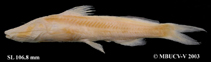
Dorsale stekels (totaal) : 1; Dorsale zachte stralen (totaal) : 6; Anale zachte stralen: 12. This species differs from its congeners by having a concave dorsal head profile (vs. convex or straight); frontal bones broadly sutured to each other anterior to small, circular remnant foramen of anterior cranial fontanelle that is anteriorly adjacent to epiphyseal bar (vs. frontals separated by anterior fontanelle widely open from mesethmoid to epiphyseal bar). It differs from all epigean Rhamdia by the following troglomorphic characters: eyes absent, complete depigmentation, widened cutaneous pores of the cephalic laterosensory system, preoperculomandibular sensory canal forming wide fossae in the dentary and preopercle (vs. narrow pores and canals). Further, this species can be distinguished from other Rhamdia species by the following set of characters: pectoral fins with a spine and ten branched rays (vs. modally eight or nine soft rays in other species); both lobes of the caudal fin pointed (vs. at least one lobe rounded); caudal skeleton with three hypural plates, PH; 1 + 2; 3 + 4 + 5 (vs. Modally four PH; 1 + 2; 3 + 4; 5 in the other species, except R. laukidi and R. jequitinhonha) (Ref. 80467).
Body shape (shape guide): elongated; Cross section: compressed.
The cave where the fish was collected is near the margin of Río Guasare and is the source of a spring during seasonal rains; its lower conduit has a 280 m course, 2-3 m wide and 1-2 m high, narrowly communicating with the access gallery. The underground river is permanently fed by a spring about 60 m into the lower gallery. At the time the collection was made, the average depth of the water course was 1.5 m with deeper pools along its course where the catfishes were observed (Ref. 80467).
Levenscyclus en paargedrag
Maturiteit | Voortplanting | Paaien | Eieren | Fecunditeit | Larven
DoNascimiento, C., F. Provenzano and J.G. Lundberg, 2004. Rhamdia guasarensis (Siluriformes: Heptapteridae) a new species of cave catfish from the Sierra de Perija´, northwestern Venezuela. Proc. Biol. Soc. Wash. 117(4):564-574. (Ref. 80467)
Status op de Rode Lijst van het IUCN (Ref. 130435: Version 2025-2 (Global))
Gevaar voor de mens
Harmless
Gebruik door de mens
Visserij: van geen belang
Tools
Speciale rapporten
Download XML
Internetbronnen
Schattingen op basis van modellen
Fylogenetische diversiteitsindex (Ref.
82804): PD
50 = 0.5000 [Uniqueness, from 0.5 = low to 2.0 = high].
Bayesian length-weight: a=0.00813 (0.00379 - 0.01743), b=2.97 (2.79 - 3.15), in cm total length, based on LWR estimates for this (Sub)family-body shape (Ref.
93245).
Trofisch niveau (Ref.
69278): 3.4 ±0.4 se; based on size and trophs of closest relatives
Weerstandsvermogen (Ref.
120179): Gemiddeld, minimale populatieverdubbelingstijd 1,4-4,4 jaar (Preliminary K or Fecundity.).
Kwetsbaarheid van de visserij (Ref.
59153): Low vulnerability (10 of 100).
🛈