Classificazione / Nomi
Nomi Comuni | Sinonimi | Catalog of Fishes(Genere, Specie) | ITIS | CoL | WoRMS | Cloffa
>
Siluriformes (Catfishes) >
Bagridae (Bagrid catfishes)
Etymology: Mystus: Greek, mystax = whiskered, used by Belon in 1553 to describe all fishes with whiskers (Ref. 45335); alasensis: Name derived from the Sungai Alas (Alas River) drainage.
Ambiente: milieu / zona climatica / distribuzione batimetrica / gamma di distribuzione
Ecologia
; acqua dolce demersale. Tropical
Asia: Sungai Alas drainage in Sumatra, Indonesia.
Dimensione / Peso / Età
Maturità: Lm ? range ? - ? cm
Max length : 10.8 cm SL maschio/sesso non determinato; (Ref. 55439)
Breve descrizione
Chiavi di identificazione | Morfologia | Morfometria
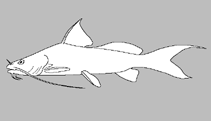
Spine dorsali (totale) : 1; Raggi dorsali molli (totale) : 7; Raggi anali molli: 12 - 14; Vertebre: 38 - 41. Distinguished from all other Southeast Asian congeners, except Mystus castaneus, M. impluviatus and M. nigriceps by the following combination of characters: a moderately long (29-37% SL), low adipose-fin, uniform body color, fossa on midline of the cranium not reaching to the base of the supraoccipital process and extremely long maxillary barbels that reach beyond the base of the caudal fin (Ref. 55439). Differs from M. castaneus, M. impluviatus and M. nigriceps in lacking a dark triangular mark at the base of the caudal fin. Further differs from M. nigriceps in having a longer (34.3-36.3% SL vs. 26.3-31.4), deeper (6.7-7.5% SL vs. 4.1-6.0) adipose fin and longer pelvic fins (17.6-20.2% SL vs. 13.4-16.7); and from M. castaenus and M. impluviatus in having a more gently-sloping dorsal profile of the head. Differs also from M. impluviatus in lacking (vs. presence) of fontanel on the supraoccipital and having a deeper adipose fin (6.7-7.5% SL vs. 4.7-6.0) (Ref. 55439).
Body shape (shape guide): elongated.
Facultative air-breathing in the genus (Ref. 126274); Oviparous, distinct pairing possibly like other members of the same family (Ref. 205).
Ciclo vitale e comportamento di accoppiamento
Maturità | Riproduzione | Deposizione | Uova | Fecondità | Larve
Ng, H.H. and R.K. Hadiaty, 2005. Two new bagrid catfish (Teleostei: Bagridae) from the Alas River drainage, northern Sumatra. Ichthyol. Explor. Freshwat. 16(1):83-92. (Ref. 55439)
Stato della Lista Rossa IUCN (Ref. 130435: Version 2025-2 (Global))
Minaccia per l'uomo
Harmless
Usi umani
Strumenti
Rapporti speciali
Scarica XML
Fonti Internet
Stime basate su modelli
Indice di diversità filogenetica (Fonte Biblio.
82804): PD
50 = 0.5000 [Uniqueness, from 0.5 = low to 2.0 = high].
Bayesian length-weight: a=0.00813 (0.00354 - 0.01865), b=2.94 (2.77 - 3.11), in cm total length, based on LWR estimates for this Genus-body shape (Ref.
93245).
Livello trofico (Fonte Biblio.
69278): 3.3 ±0.4 se; based on size and trophs of closest relatives
Resilienza (Fonte Biblio.
120179): Medio, tempo minimo di raddoppiamento della popolazione 1.4 - 4.4 anni (Assuming Fec < 10,000).
Vulnerabilità della pesca (Ref.
59153): Low vulnerability (10 of 100).
🛈
Nutrienti (Ref.
124155): Calcium = 346 [186, 855] mg/100g; Iron = 3.23 [1.59, 5.89] mg/100g; Protein = 16 [15, 17] %; Omega3 = 0.356 [0.131, 0.935] g/100g; Selenium = 57.6 [20.7, 156.5] μg/100g; VitaminA = 78.2 [24.8, 240.5] μg/100g; Zinc = 2.6 [1.5, 4.3] mg/100g (wet weight);