>
Siluriformes (Catfishes) >
Ictaluridae (North American freshwater catfishes)
Etymology: Noturus: Greek, noton = back + Greek, oura = tail; refred to the position of the tail over the back (Ref. 45335); gladiator: From the Latin gladiator, meaning swordsman, in reference to the large and serrated pectoral spines of this species.
Environnement : milieu / zone climatique / profondeur / gamme de distribution
Écologie
; eau douce démersal; non migrateur (Ref. 126106); profondeur 0 - 1 m (Ref. 55397). Subtropical; ? - 26°C (Ref. 55397)
North America: coastal plain streams of Tennessee and Mississippi, USA.
Taille / Poids / Âge
Maturité: Lm ? range ? - ? cm
Max length : 10.7 cm SL mâle / non sexé; (Ref. 55397)
Description synthétique
Clés d'identification | Morphologie | Morphométrie
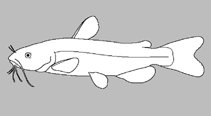
Épines dorsales (Total) : 1; Rayons mous dorsaux (Total) : 6 - 7; Rayons mous anaux: 12 - 15; Vertèbres: 33 - 34. A member of Noturus furiosus species group distinguished from all other members by its exceptionally bold pigment pattern, with particular reference to the following markings: dark brown to black dorsal saddles highly contrasted with pale yellow to tan areas on body; posterior dark saddle passing through adipose fin extends to middle of anal fin base, posterior to terminus of caudal peduncle, forming a well-defined broad lateral band of dense pigment; dorsal fin with dark, broad submarginal and basal bands connected anteriorly via first 2-3 rays; anal fin with dark central blotch extending onto base and often connected to intense dark pigment on sides of caudal peduncle; dark, crescent-shaped midcaudal band, thickest in center where broadly joined to dark pigment on caudal peduncle. Differs also by the following combination of characters: pectoral spine with strongly developed anterior dentations, some often bifurcate; pectoral spine, its posterior serrae, and the posterior process of cleithrum very large; pectoral fin long, sickle-shaped, and when depressed, reach beyond pelvic fin origin, except in very large specimens (Ref. 55397).
Adults inhabit mainstream rivers of small to medium size and the lower reaches of their major tributaries (Ref. 55397). Most commonly associated with moderate velocities, moderate depth (about 60 cm), clean sand or clay substrata and cover in the form of leaf packs, brush and log jams (Ref. 55397).
Cycle de vie et comportement reproducteur
Maturité | Reproduction | Frai | Œufs | Fécondité | Larves
Thomas, M.R. and B.M. Burr, 2004. Noturus gladiator, a new species of madtom (Siluriformes: Ictaluridae) from Coastal Plain streams of Tennessee and Mississippi. Ichthyol. Explor. Freshwat. 15(4):351-368. (Ref. 55397)
Statut dans la liste rouge de l'IUCN (Ref. 130435: Version 2025-2 (Global))
Menace pour l'homme
Harmless
Utilisations par l'homme
Outils
Articles particuliers
Télécharger en XML
Sources Internet
Estimations basées sur des modèles
Indice de diversité phylogénétique (Réf.
82804): PD
50 = 0.5000 [Uniqueness, from 0.5 = low to 2.0 = high].
Bayesian length-weight: a=0.00589 (0.00256 - 0.01357), b=3.07 (2.87 - 3.27), in cm total length, based on LWR estimates for this (Sub)family-body shape (Ref.
93245).
Niveau trophique (Réf.
69278): 3.3 ±0.4 se; based on size and trophs of closest relatives
Résilience (Réf.
120179): Haut, temps minimum de doublement de population inférieur à 15 mois (Preliminary K or Fecundity.).
Vulnérabilité de la pêche (Ref.
59153): Low vulnerability (10 of 100).
🛈