Classificazione / Nomi
Nomi Comuni | Sinonimi | Catalog of Fishes(Genere, Specie) | ITIS | CoL | WoRMS | Cloffa
>
Cypriniformes (Carps) >
Cyprinidae (Minnows or carps) > Smiliogastrinae
Etymology: Dawkinsia: Named for Richard Dawkins, for his contribution to the public understanding of science and, in particular, of evolutionary science.
Eponymy: Dr Clinton Richard Dawkins (d: 1941) is an ethologist and evolutionary biologist who was Professor for Public Understanding of Science (1995–2008) at Oxford, which had awarded both his bachelor’s degree (1962) and his doctorate (1966) and where he [...] (Ref. 128868), visit book page.
More on author: Jerdon.
Ambiente: milieu / zona climatica / distribuzione batimetrica / gamma di distribuzione
Ecologia
; acqua dolce benthopelagico. Tropical
Asia: India.
Dimensione / Peso / Età
Maturità: Lm ? range ? - ? cm
Max length : 11.2 cm SL maschio/sesso non determinato; (Ref. 55036)
Breve descrizione
Chiavi di identificazione | Morfologia | Morfometria
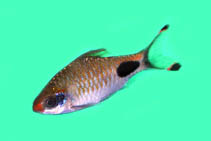
Adults measuring >4.33 cm SL differ from all other South Asian Puntius by a combination of the following characters: a black band about as wide as eye across each caudal-fin lobe (faint or absent in adults of the Kallada River population); lower lip continuous, a caudal blotch on 2-5 scales, commencing posterior to anal-fin origin; no distinct markings on body in advance of anal-fin origin. Adult males from the Chalakudy and Kallada River populations with branched dorsal rays prolonged into filament-like extensions. Adults of P. assimilis may be distinguished from P. filamentosus by possessing mouth inferior (vs. subterminal) and maxillary barbels 23.5-33.3% HL (vs. 2.8-8.1%) (Ref. 55036).
Body shape (shape guide): fusiform / normal.
Occurs in a variety of habitats such slow-flowing areas close to the banks with muddy substrate, clear-water, rock substrate areas and relatively fast-flowing waters (Ref. 55036).
Ciclo vitale e comportamento di accoppiamento
Maturità | Riproduzione | Deposizione | Uova | Fecondità | Larve
Pethiyagoda, R. and M. Kottelat, 2005. A review of the barb of the Puntius filamentosus group (Teleostei: Cyprinidae) of southern India and Sri Lanka. Raffles Bull. Zool. Suppl. 12:127-144. (Ref. 55036)
Stato della Lista Rossa IUCN (Ref. 130435: Version 2025-2 (Global))
Minaccia per l'uomo
Harmless
Usi umani
Strumenti
Rapporti speciali
Scarica XML
Fonti Internet
Stime basate su modelli
Indice di diversità filogenetica (Fonte Biblio.
82804): PD
50 = 0.5001 [Uniqueness, from 0.5 = low to 2.0 = high].
Bayesian length-weight: a=0.01072 (0.00504 - 0.02277), b=3.02 (2.84 - 3.20), in cm total length, based on LWR estimates for this (Sub)family-body shape (Ref.
93245).
Livello trofico (Fonte Biblio.
69278): 2.6 ±0.1 se; based on size and trophs of closest relatives
Resilienza (Fonte Biblio.
120179): Alto, tempo minimo di raddoppiamento della popolazione meno di 15 mesi (Preliminary K or Fecundity.).
Vulnerabilità della pesca (Ref.
59153): Low vulnerability (10 of 100).
🛈