Classificazione / Nomi
Nomi Comuni | Sinonimi | Catalog of Fishes(Genere, Specie) | ITIS | CoL | WoRMS | Cloffa
>
Siluriformes (Catfishes) >
Loricariidae (Armored catfishes) > Hypostominae
Etymology: Hemiancistrus: Greek, hemi = the half + Greek, agkistron = hook (Ref. 45335); votouro: The specific name votouro is given in honor of the Votouro Indian Reserve, located on Benjamin Constant, Rio Grande do Sul, Brazil.
Ambiente: milieu / zona climatica / distribuzione batimetrica / gamma di distribuzione
Ecologia
; acqua dolce demersale. Subtropical
South America: upper Uruguay River basin in Brazil.
Dimensione / Peso / Età
Maturità: Lm ? range ? - ? cm
Max length : 14.1 cm SL maschio/sesso non determinato; (Ref. 54753)
Breve descrizione
Chiavi di identificazione | Morfologia | Morfometria
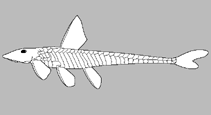
Spine dorsali (totale) : 2; Raggi dorsali molli (totale) : 7; Spine anali: 1; Raggi anali molli: 4. Distinguished from all other species of Hemiancistrus except H. chlorostictus, H. meizospilos, H. megacephalus and H. macrops by the presence of light dots on all fins and the lateral and dorsal portions of body. H. votouro differs from H. chlorostictus by having more premaxillary teeth (61-79 vs. 30-54), larger adipose-fin spine (9.0-10.4% SL vs. 5.8-8.0% SL), deeper caudal peduncle (11.0-11.8% SL vs. 9.6-10.4% SL), larger pectoral fin (36.2-41.3% SL vs. 30.6-35.4% SL); larger exposed portion of cleithrum (11.2-12.7% SL vs. 9.3-10.6% SL), narrower body at dorsal-fin origin (17.9-19.8% SL vs. 19.9-25.3% SL) and first anal-fin pterygiophore not exposed (vs. exposed). H. votouro differs from H. meizospilos by the smaller orbit diameter (14.5-16.7% HL vs. 16.7-21.0% HL) and much smaller light markings (one to three dots per plate vs. one large dot occupying one to three plates and skin between them). H. votouro is distinguished from H. megacephalus and H. macrops by the number of the light markings per body plate (one to three small dots per plate vs. only one large dot on each body plate) (Ref. 54753).
Body shape (shape guide): elongated.
Facultative air-breathing in the genus (Ref. 126274); Found in a 2-5 m wide stream, with rocky and sandy bottom, small rapids separated by pools and marginal vegetation moderately preserved (Ref. 54753).
Ciclo vitale e comportamento di accoppiamento
Maturità | Riproduzione | Deposizione | Uova | Fecondità | Larve
Cardoso, A.R. and J.F.P. da Silva, 2004. Two new species of the genus Hemiancistrus Bleeker (Teleostei: Siluriformes: Loricariidae) from the upper rio Uruguai basin. Neotrop. Ichthyol. 2(1):1-8. (Ref. 54753)
Stato della Lista Rossa IUCN (Ref. 130435: Version 2025-2 (Global))
Minaccia per l'uomo
Harmless
Usi umani
Strumenti
Rapporti speciali
Scarica XML
Fonti Internet
Stime basate su modelli
Indice di diversità filogenetica (Fonte Biblio.
82804): PD
50 = 0.5000 [Uniqueness, from 0.5 = low to 2.0 = high].
Bayesian length-weight: a=0.01549 (0.00726 - 0.03306), b=2.96 (2.79 - 3.13), in cm total length, based on LWR estimates for this (Sub)family-body shape (Ref.
93245).
Resilienza (Fonte Biblio.
120179): Medio, tempo minimo di raddoppiamento della popolazione 1.4 - 4.4 anni (Preliminary K or Fecundity.).
Vulnerabilità della pesca (Ref.
59153): Low vulnerability (10 of 100).
🛈