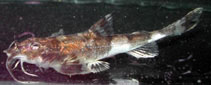
Classificatie / Namen
Lokale namen | Synoniemen | Catalog of Fishes(Genus, Soort(en)) | ITIS | CoL | WoRMS | Cloffa
>
Siluriformes (Catfishes) >
Sisoridae (Sisorid catfishes) > Sisorinae
Etymology: Erethistoides: Greek, erethizo = that irritates + Greek, suffix oides = similar (Ref. 45335); sicula: From the Latin sicula, meaning dagger, in reference to the short pectoral spines of this species. Used as a noun.
Milieu: milieu / Klimaatzone / Diepte / verspreidingsgebied
Ecologie
; zoet water demersaal. Tropical
Asia: known from the Mansai River drainage, itself a tributary of the Brahmaputra River in northern West Bengal state in India (Ref. 54978).
Grootte / Gewicht / Leeftijd
Maturiteit: Lm ? range ? - ? cm
Max length : 3.9 cm SL mannelijk / geslacht onbekend; (Ref. 54978)
Korte beschrijving
Determinatiesleutels | Morfologie | Morfometrie
Dorsale zachte stralen (totaal) : 5; Anale zachte stralen: 10 - 11; Wervels: 29 - 31. Erethistoides sicula differs from both E. montana and E. pipri in having a
longer caudal peduncle (19.6–22.3% SL vs. 14.4–18.4) and shorter pectoral spine (14.6–28.0% SL vs. 30.7–32.1). It further differs from E. montana in having a dorsally projecting bony splint on the opercle immediately posterior to its articular facet with the hyomandibula (vs. splint absent; Fig. 2) and from E. pipri in having a more slender head (13.4–15.1% SL vs. 16.4).
Body shape (shape guide): elongated; Cross section: flattened.
Levenscyclus en paargedrag
Maturiteit | Voortplanting | Paaien | Eieren | Fecunditeit | Larven
Ng, H.H., 2005. Erethistoides sicula, a new catfish (Teleostei: Erethistidae) from India. Zootaxa 1021:1-12. (Ref. 54978)
Status op de Rode Lijst van het IUCN (Ref. 130435: Version 2025-2 (Global))
Gevaar voor de mens
Harmless
Gebruik door de mens
Tools
Speciale rapporten
Download XML
Internetbronnen
Schattingen op basis van modellen
Fylogenetische diversiteitsindex (Ref.
82804): PD
50 = 0.5010 [Uniqueness, from 0.5 = low to 2.0 = high].
Bayesian length-weight: a=0.00676 (0.00310 - 0.01476), b=3.03 (2.85 - 3.21), in cm total length, based on LWR estimates for this (Sub)family-body shape (Ref.
93245).
Trofisch niveau (Ref.
69278): 3.1 ±0.4 se; based on size and trophs of closest relatives
Kwetsbaarheid van de visserij (Ref.
59153): Low vulnerability (10 of 100).
🛈