Classificatie / Namen
Lokale namen | Synoniemen | Catalog of Fishes(Genus, Soort(en)) | ITIS | CoL | WoRMS | Cloffa
>
Siluriformes (Catfishes) >
Loricariidae (Armored catfishes) > Hypostominae
Etymology: Ancistrus: Greek, agkistron = hook (Ref. 45335); jataiensis: The specific name jataiensis is derived from Jatai, the name of the only river where the species was found.
Milieu: milieu / Klimaatzone / Diepte / verspreidingsgebied
Ecologie
; zoet water demersaal. Tropical
South America: known only from the type locality, a small tributary of the rio Vermelho, upper Tocantins basin in Brazil.
Grootte / Gewicht / Leeftijd
Maturiteit: Lm ? range ? - ? cm
Max length : 5.4 cm SL mannelijk / geslacht onbekend; (Ref. 54498)
Korte beschrijving
Determinatiesleutels | Morfologie | Morfometrie
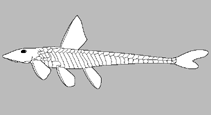
Dorsale zachte stralen (totaal) : 8; Anale zachte stralen: 5; Wervels: 28. Distinguished from all congeners except Ancistrus tombador and A. reisi by the absence of an adipose fin. Adipose fin is replaced by a series of 2 to 4 median unpaired platelets forming a low crest. These platelets are nearly immediately followed by the plate-like procurrent caudal rays, while in A. tomabador these are followed by at least two lateral plates that join dorsally before the procurrent caudal rays. It further differs from A. tombador by the following characters: snout with naked margin generally ill-delimited by posterior dermal plates which are irregular in size and shape and rarely joined together; tentacles present, some branched in larger males; body wider (cleithral width 33.6-35.6% SL, mean 34.9) and caudal peduncle depth 10.1-10.7% SL, mean 10.4. Differs from A. reisi by the following morphometric characters: predorsal length (47.5-49.3% SL, mean 48.1, vs. 43.8-46.4% SL, mean 44.9), occipital depth (17.0-19.5% SL, mean 18.1, versus 14.9-17.0% SL, mean 16) and caudal peduncle length (24.6-27.1% SL, mean 26.3, vs. 27.7-30.9%SL, mean 28.7) (Ref. 54498).
Body shape (shape guide): elongated.
Facultative or obligate air-breathing (Ref. 126274)
Levenscyclus en paargedrag
Maturiteit | Voortplanting | Paaien | Eieren | Fecunditeit | Larven
Fisch-Muller, S., A.R. Cardoso, J.F.P. da Silva and V.A. Bertaco, 2005. Three new species of Ancistrus Kner (Teleostei: Siluriformes: Loricariidae) from the upper Tapajós and Tocantins rivers. Rev. Suisse de Zoologie 112(2):559-572. (Ref. 54498)
Status op de Rode Lijst van het IUCN (Ref. 130435: Version 2025-2 (Global))
Gevaar voor de mens
Harmless
Gebruik door de mens
Visserij: van geen belang
Tools
Speciale rapporten
Download XML
Internetbronnen
Schattingen op basis van modellen
Fylogenetische diversiteitsindex (Ref.
82804): PD
50 = 0.5000 [Uniqueness, from 0.5 = low to 2.0 = high].
Bayesian length-weight: a=0.01479 (0.00636 - 0.03440), b=2.98 (2.80 - 3.16), in cm total length, based on LWR estimates for this Genus-body shape (Ref.
93245).
Kwetsbaarheid van de visserij (Ref.
59153): Low vulnerability (10 of 100).
🛈