Klassificering / Namn
Populärnamn | synonymer | Catalog of Fishes(Släkte, Arter) | ITIS | CoL | WoRMS | Cloffa
>
Cypriniformes (Carps) >
Cyprinidae (Minnows or carps) > Smiliogastrinae
Etymology: Pethia: Pethia is the generic vernacular name for small cyprinids in Sinhala; tiantian: Specific name derived from tiantian, Mandarin Chinese, meaning heaven. This is in reference to the habitat of the species which is in streams at the foot Himalayas, that is, somewhat close to heaven; noun in apposition.
Eponymy: Tiantian Kullander is the senior author’s son. He, along with his brother ‘Didi’, “…had to repeatedly suffer their parents’ absence searching for these and other fish in faraway lands.” (Also see Kullander & Didi) (Ref. 128868), visit book page.
More on authors: Kullander & Fang.
Miljö: miljö / Klimatzon / djupintervall / distributionsområde
Ekologi
; sötvatten bentopelagisk; djupintervall 0 - 1 m (Ref. 54351). Tropical
Asia: northern Myanmar.
Storlek / Vikt / Ålder
Könsmognad: Lm ? range ? - ? cm
Max length : 4.5 cm SL hane/ej könsbestämd; (Ref. 54351)
Kort beskrivning
Bestämningsnycklar | Morfologi | Morfometri
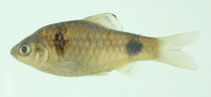
Taggstrålar i ryggfenan (totalt) : 0; Mjukstrålar i ryggfenan (totalt) : 11 - 12; Taggstrålar i analfenan: 0; Mjukstrålar i analfenan: 8; Ryggkotor: 29 - 31. A member of the Puntius conchonius group uniquely distinguishable by the shape of the last unbranched dorsal fin ray which is slender, flexible and with short serrations posteriorly. Similar to P. cumingii, P. didi and P. meingangbii by presence of a dark vertical bar anteriorly on side and a dark round blotch on caudal peduncle; differs from these species by lateral line continued to caudal fin base vs. present on only 5 to 10 scales. Distinguished from the geographically close P. didi by body depth 35.4-39.8% SL vs. 40.4-48.2% SL and dorsal fin length 23.2-26.0% SL vs. 26.6-31.8% SL, and males with a single dark band across dorsal and anal fin vs. two series of black elongate marks in dorsal fin and one series of black marks in anal fin (Ref. 54351).
Body shape (shape guide): fusiform / normal.
Occurs in a small hill stream, about 3 m wide on average, flowing through low forest, with grass and shrub along banks and over a varied bottom with rock, gravel and sand (Ref. 54351).
Livscykel och parningsbeteende
Könsmognad | Reproduktion | Lek | Ägg | Fekunditet | Larver
Kullander, S.O. and F. Fang, 2005. Two new species of Puntius from northern Myanmar (Teleostei: Cyprinidae). Copeia 2005(2):290-302. (Ref. 54351)
Status på IUCN:s rödlista (Ref. 130435: Version 2025-2 (Global))
Hot mot människor
Harmless
Mänskliga användningsområden
Verktyg
Särskilda rapporter
Ladda ner XML
Internet-källor
Uppskattningar baserade på modeller
Index för fylogenetisk mångfald (Ref.
82804): PD
50 = 0.5000 [Uniqueness, from 0.5 = low to 2.0 = high].
Bayesian length-weight: a=0.01047 (0.00454 - 0.02413), b=3.00 (2.83 - 3.17), in cm total length, based on LWR estimates for this Genus-body shape (Ref.
93245).
Trofisk nivå (Ref.
69278): 2.7 ±0.2 se; based on size and trophs of closest relatives
Resiliens (Ref.
120179): Hög, lägsta populationsfördubblingstid mindre än 15 månader (Preliminary K or Fecundity.).
Sårbarhet i fisket (Ref.
59153): Low vulnerability (10 of 100).
🛈