>
Gobiiformes (Gobies) >
Gobiidae (Gobies) > Gobiinae
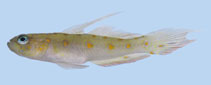
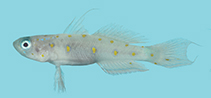
Etymology: nannai: Named after the Sumerian moon god, Sin, who had several names corresponding to its different phases; the name 'Nanna' represented the full moon, in allusion to the moon-like lateral spots on the body.
Eponymy: Professor Cornelius Jan van der Horst (1889–1951) was a Dutch zoologist who moved to South Africa (1928) and became Head of the Zoology Department, Witwatersrand University, Johannesburg. [...] This refers to the Sumerian moon god Sin, who had several different names corresponding to phases of the moon; the name ‘Nanna’ represented the full moon, referring to moon-like lateral spots on this goby. (Ref. 128868), visit book page.
More on authors: Winterbottom, Iwata & Kozawa.
Ambiente: milieu / zona climática / intervalo de profundidade / gama de distribuição
Ecologia
marinhas demersal; intervalo de profundidade 5 - 20 m (Ref. 90102). Tropical
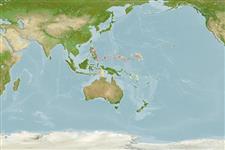
Western Pacific: Palau and the Philippines.
Tamanho / Peso / Idade
Maturidade: Lm ? range ? - ? cm
Max length : 3.3 cm SL macho/indeterminado; (Ref. 53948); 3.0 cm SL (female)
Descrição breve
Chaves de identificação | Morfologia | Morfometria
Espinhos dorsais (total) : 7; Raios dorsais moles (total) : 11; Espinhos anais: 1; Raios anais moles: 11; Vértebras: 26. This species is distinguished by the following characters: shares with Vanderhorstia papillo the elongated 5" (upper lobe) and 9" (lower lobe) branched caudal fin rays; differs from V. papillo in having more lateral scales (41-45 vs. 27); no scales in the predorsal midline (vs. 11); a unique color pattern (off-white background with large yellow spots along the midlateral body vs. such spots absent, and absence of four dark gray brown saddles on body vs. present); adults with both third and fourth dorsal spines elongate; more lower gill rakers on the first arch (16-17 vs. 10); fewer pseudobranch filaments (6-7 vs. 9); a single papilla in row c on the cheek (vs. 4) and row b not interrupted (vs. in two sections) (Ref. 53948).
Body shape (shape guide): elongated; Cross section: compressed.
Based on a photo taken from the Philippines, it is reasonable to assume that it is associated with burrows made and occupied by alphaeid shrimps (albeit no visible evidence of the shrimp in the image), as is the case in all it congeners for which information is available (Ref. 53948). Found in sand-rubble bottoms in 5-20 m (Ref 90102).
Ciclo de vida e comportamento de acasalamento
Maturidade | Reprodução | Desova | Ovos | Fecundidade | Larvas
Winterbottom, R., A. Iwata and T. Kozawa, 2005. Vanderhorstia nannai, a new species of burrow-associated goby from Palau and the Philippines (Pisces: Gobiidae). aqua, J. Ichthyol. Aquat. Biol. 9(3):109-114. (Ref. 53948)
Categoria na Lista Vermelha da IUCN (Ref. 130435: Version 2025-2 (Global))
Ameaça para o homem
Harmless
Utilização humana
Ferramentas
Relatórios especiais
Descarregue XML
Fontes da internet
Estimativas baseadas em modelos
Temperatura preferida (Ref.
123201): 28.7 - 29.4, mean 29 °C (based on 212 cells).
Índice de diversidade filogenética (Ref.
82804): PD
50 = 0.5000 [Uniqueness, from 0.5 = low to 2.0 = high].
Bayesian length-weight: a=0.00741 (0.00347 - 0.01582), b=3.09 (2.91 - 3.27), in cm total length, based on LWR estimates for this (Sub)family-body shape (Ref.
93245).
Nível Trófico (Ref.
69278): 3.1 ±0.3 se; based on size and trophs of closest relatives
Resiliência (Ref.
120179): Elevada, tempo mínimo de duplicação da população menor que 15 meses (Preliminary K or Fecundity.).
Vulnerabilidade da pesca (Ref.
59153): Low vulnerability (10 of 100).
🛈