Classification / Noms
Noms communs | Synonymes | Catalog of Fishes(Genre, Espèce) | ITIS | CoL | WoRMS | Cloffa
>
Salmoniformes (Salmons) >
Salmonidae (Salmonids) > Coregoninae
Etymology: Coregonus: Greek, kore = pupils of the eye + Greek, gonia = angle (Ref. 45335); fontanae: Named for the German poet Theodor Fontane (1819-1898) who published several books reflecting his love for the state Brandenburg. He dedicated his last book to the people and landscape around Lake Stechlin.
Eponymy: Theodor Fontane (1819–1898) was a German poet. He published several books extolling his love for Brandenburg. He dedicated his last book to the people and landscape around Lake Stechlin, Germany, where this species is endemic. (Ref. 128868), visit book page.
More on authors: Schulz & Freyhof.
Environnement : milieu / zone climatique / profondeur / gamme de distribution
Écologie
; eau douce benthopélagique; profondeur ? - 3 m (Ref. 52872). Temperate
Europe: Lake Stechlin in northern Germany.
Longueur à la première maturité / Taille / Poids / Âge
Maturité: Lm 8.8, range 7 - 11 cm
Max length : 12.6 cm SL mâle / non sexé; (Ref. 52872)
Description synthétique
Clés d'identification | Morphologie | Morphométrie
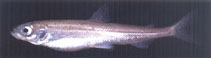
Distinguished from the sympatric Coregonus albula, the geographically close Coregonus lucinensis and the spring spawning Coregonus trybomi by: scales in lateral line 69-77 + 3; interorbital distance 25-30% of dorsal head length; head width between dorsal end of opercular openings 8.2-9.7% SL; body depth at dorsal fin origin 16.4-21.2% SL; length of last gill raker in upper branch of first gill arch 120-186% of opposite outer gill filament; 11-18% of dorsal head length; pelvic and pectoral fins hyaline; slow growth, mature females 8.7-12.6 cm SL (Ref. 52872).
Body shape (shape guide): elongated.
Found in lakes, inhabiting deep water layers of 20-60 m. Undertakes migration above 20 m at night (Ref. 59043). Most abundant below 20 m depth (Ref. 52872). Syntopic with Coregonus albula in Lake Stechlin (Ref. 52872). Feeds mainly on Cladocera and Copepoda (Ref. 59043).
Cycle de vie et comportement reproducteur
Maturité | Reproduction | Frai | Œufs | Fécondité | Larves
Schulz, M. and J. Freyhof, 2003. Coregonus fontanae, a new spring-spawning cisco from Lake Stechlin, northern Germany (Salmoniformes: Coregonidae). Ichthyol. Explor. Freshwat. 14(3):209-216. (Ref. 52872)
Statut dans la liste rouge de l'IUCN (Ref. 130435: Version 2025-2 (Global))
Menace pour l'homme
Harmless
Utilisations par l'homme
Outils
Articles particuliers
Télécharger en XML
Sources Internet
Estimations basées sur des modèles
Indice de diversité phylogénétique (Réf.
82804): PD
50 = 0.5000 [Uniqueness, from 0.5 = low to 2.0 = high].
Bayesian length-weight: a=0.00457 (0.00193 - 0.01082), b=3.13 (2.92 - 3.34), in cm total length, based on LWR estimates for this (Sub)family-body shape (Ref.
93245).
Niveau trophique (Réf.
69278): 3.3 ±0.3 se; based on size and trophs of closest relatives
Résilience (Réf.
120179): Haut, temps minimum de doublement de population inférieur à 15 mois (Preliminary K or Fecundity.).
Vulnérabilité de la pêche (Ref.
59153): Low vulnerability (10 of 100).
🛈