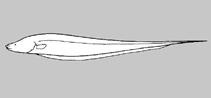
การจำแนกประเภท / ชื่อ
ชื่อสามัญ | ชื่อพ้อง | Catalog of Fishes(สกุล, ชนิด) | ITIS | CoL | WoRMS | Cloffa
>
Gymnotiformes (Knifefishes) >
Sternopygidae (Glass knifefishes) > Sternopyginae
Etymology: Sternopygus: Greek, sternon = sternon, + Greek, pyge = tail (Ref. 45335); branco: Specific epithet from the Portuguese word meaning white, referring to the characteristic pale color of freshly netted live specimens; noun in apposition.
สิ่งแวดล้อม : สิ่งแวดล้อม / เขตภูมิอากาศ / ระดับความลึก / ระยะการกระจายสินค้า
นิเวศวิทยา
; น้ำจืด กลุ่มสัตว์หน้าดิน,กลุ่มสัตว์พื้นท้องน้ำ. Tropical
South America: Amazon River, Brazil.
ขนาด / น้ำหนัก / อายุ
วัยเจริญพันธุ์: Lm ? range ? - ? cm
Max length : 49.2 cm TL เพศผู้/กระเทย; (Ref. 52797)
คำอธิบายสั้นๆ
เครื่องมือที่ใช้ในการแยกชนิดสัตว์,สิ่งมีชีวิตออกจากกัน | สัณฐานวิทยา | ความยาวต่างๆ
ก้านครีบอ่อนที่ก้น: 250 - 340.
Occurs in the main channels of major rivers or side branches; not known to occur in seasonally inundated floodplain forests or in forest steams of the Amazon's terra firme. In the Tefé region, this species is caught with beach seines and trawl nets at depth up to 10 meters in areas with weak currents, such as in large eddies, sheltered bays or "paranás" (side-branches of the main river channels that wind their way through the whitewater "várzea" floodplain); occurs syntopically with Sternopygus macrurus in whitewater habitats, but never with Sternopygus atrabes. This species does not occur where currents near the substrate exceeded 0.1 m/sec. At daytime it is usually encountered near submerged structures such as fallen trees and driftwood, and at night it moves into shallower water and away from structures. Specimens are collected on both sand and mud bottoms. It does not live in groups as indicated by electrode surveys and its sporadic occurrence in nets. Sexually mature males were never encountered, but gravid females were found along the edge of whitewater floodplain areas and in paraná channels during the rising water months of January and February. Feeds mainly on autochthonous insect larvae which it encounters on the substrate; the presence of small pieces of wood in many of the stomachs indicate that it forages among organic detritus on the river bed rather than within rafts of floating meadows or marginal macrophytes (Ref. 55493).
วงจรชีวิตและพฤติกรรมการผสมพันธุ์
วัยเจริญพันธุ์ | การสืบพันธุ์ | การวางไข่ | เซลสืบพันธ์ของเพศเมีย(ไข่) | ความดกของไข่ | ตัวอ่อน
Crampton, W.G.R., K.G. Hulen and J.S. Albert, 2004. Redescription of Sternopygus obtusirostris (Gymnotiformes: Sternopygidae) from the Amazon basin, with description of osteology, ecology and electric organ discharges. Ichthyol. Explor. Freshwat. 15(2):121-134. (Ref. 52797)
สถานะบัญชีแดงของ IUCN (Ref. 130435: Version 2025-2 (Global))
ภัยคุกคามต่อมนุษย์
Harmless
การใช้ของมนุษย์
เครื่องมือ
รายงานพิเศษ
ดาวน์โหลด XML
แหล่งที่มาจากอินเตอร์เน็ต
การประมาณค่าตามแบบจำลอง
ดัชนีความหลากหลายทางวิวัฒนาการ (อ้างอิง
82804): PD
50 = 0.5010 [Uniqueness, from 0.5 = low to 2.0 = high].
Bayesian length-weight: a=0.00347 (0.00144 - 0.00832), b=3.01 (2.80 - 3.22), in cm total length, based on LWR estimates for this (Sub)family-body shape (Ref.
93245).
ระดับชั้นอาหาร (อ้างอิง
69278): 2.6 ±0.27 se; based on food items.
ความเสี่ยงต่อการตกปลา (Ref.
59153): Moderate vulnerability (39 of 100).
🛈