Klassifizierung / Names
Namen | Synonyme | Catalog of Fishes(Gattung, Arten) | ITIS | CoL | WoRMS | Cloffa
Umwelt: Milieu / Klimazone / Tiefenbereich / Verbreitungsgebiet
Ökologie
; süßwasser benthopelagisch. Subtropical
Europe: Evrotas and upper main Alphios basin in Greece.
Größe / Gewicht / Alter
Geschlechtsreife: Lm ? range ? - ? cm
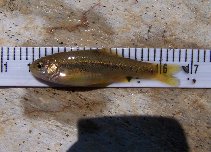
Max length : 4.7 cm SL Männchen/unbestimmt; (Ref. 52474); 6.0 cm SL (female)
Rückenflossenweichstrahlen (insgesamt) : 10; Afterflossenweichstrahlen: 8; Wirbelzahl: 34 - 35. Diagnosis: Scales in midlateral row 44-48 + 1-2; pored lateral line scales 0-8; head and snout stout and rounded; branched anal fin rays 6-61/2; scale rows on caudal peduncle usually 1/2 10 1/2 ; scale pockets much developed, exposed, covering about half of the exposed scale area; general coloration dark brown, with numerous melanophores on flank, more or less organized in small spots, and denser near midlateral stripe, which appears with somewhat fuzzy edges (Ref. 52474).
Body shape (shape guide): elongated.
Found in springs and spring-fed creeks and in the mainstream of Evrotas and upper main Alphios. Occurs in shallow areas, with slow or no current, close to the shore, among overhanging roots and dense vegetation. Feeds on variety of plants, insects and microcrustaceans. Attains maturity in the second year of life and spawns between mid-March and June (Ref. 52474).
Lebenszyklus und Paarungsverhalten
Geschlechtsreife | Fortpflanzung | Ablaichen | Eier | Fruchtbarkeit | Larven
Kottelat, M. and R. Barbieri, 2004. Pseudophoxinus laconicus, a new species of minnow from Peloponnese, Greece, with comments on the West Balkan Pseudophoxinus species (Teleostei: Cyprinidae). Ichthyol. Explor. Freshwat. 15(2):147-160. (Ref. 52474)
IUCN Rote Liste Status (Ref. 130435: Version 2025-2 (Global))
Bedrohung für Menschen
Harmless
Nutzung durch Menschen
Tools
Zusatzinformationen
Download XML
Internet Quellen
Schätzungen auf der Grundlage von Modellen
Phylogenetischer Diversitätsindex (Ref.
82804): PD
50 = 0.5078 [Uniqueness, from 0.5 = low to 2.0 = high].
Bayesian length-weight: a=0.00832 (0.00390 - 0.01775), b=3.09 (2.91 - 3.27), in cm total length, based on LWR estimates for this (Sub)family-body shape (Ref.
93245).
Trophische Ebene (Ref.
69278): 3.1 ±0.3 se; based on size and trophs of closest relatives
Widerstandsfähigkeit (Ref.
120179): hoch, Verdopplung der Population dauert weniger als 15 Monate. (Preliminary K or Fecundity.).
Anfälligkeit der Fischerei (Ref.
59153): Low vulnerability (10 of 100).
🛈